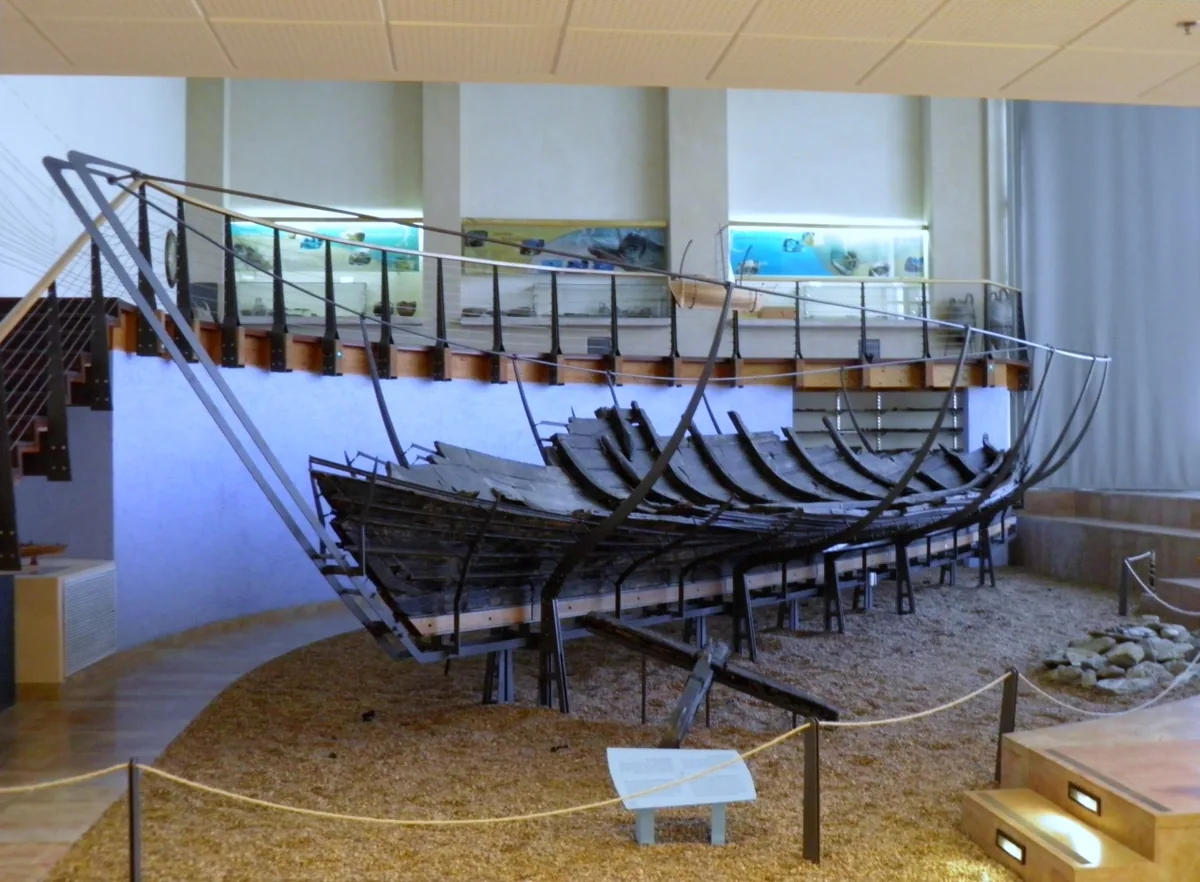
Site · Egypt · 3 min read, approximately
Abu Mena: a pilgrimage site from Byzantine to Arab rule
The Met's timeline mentions Abu Mena twice: as a Christian pilgrimage destination in the early sixth century, and as a complex restored around 750, under Arab rule. What those two sentences show about continuity, and what they do not.
The explanations distinguish finds, interpretations and open questions. Sources appear at the end of the page.
What the source says
On the Met's timeline page for Egypt, 500-1000 CE, an event dated to the "early 500s" states that "the fourth-century site dedicated to the Egyptian saint Menas", now Abu Mena, southwest of Alexandria, becomes "a highly important Christian pilgrimage destination". An event dated ca. 750 states that "the sixth-century pilgrimage complex of Saint Menas is restored", and the source adds that the restoration attests to the continued veneration of the saint under Arab rule. Source 1.
Three dates and two pages
The source gives three anchors: a dedication in the fourth century, the status of a pilgrimage destination in the early sixth century, and a restoration around 750. The last two fall clearly within the site's periods: the early sixth century in Byzantine rule in Egypt (ca. 330-616), and 750 in the early Islamic period (641-969), so the article is placed on both pages. "Fourth century", on the other hand, crosses the 330 boundary between the Roman and Byzantine periods, and the article does not say on which side of it the place was dedicated. The year 750 is itself the point at which the timeline passes from Umayyad to Abbasid rule, and the source does not say under which of the two the restoration took place. Source 1.
What can be said about continuity
A dated restoration is evidence of one action at one time. It shows that around 750, about a century after the Arab conquest (639-642), the complex was restored, and the source reads this as continued veneration. The source does not answer what happened at the place between the conquest and the restoration, who carried out the restoration, what exactly was restored, or whether pilgrimage continued on the same scale. "Continuity" here is the source's claim about veneration, not a description of uninterrupted activity. Source 1.
Two Christian sites on one timeline
Abu Mena and the monastery at Mount Sinai, the two Christian places of Byzantine Egypt on this site, appear on the same timeline page, but in different detail. For Abu Mena the page gives only two points in time; for the Sinai monastery it adds a fortification under Justinian I (548-565) and a renaming in honour of Saint Catherine (900-1100). The comparison shows how little can be said about a place that has only two dates on the timeline. Source 1.
Scope of reading: the Met timeline page for Egypt, 500-1000 CE, was read on 24 October 2026. Excavation reports on Abu Mena were not read, so this page gives no plan, levels or finds from the place itself. The page also lists a work titled "Ampulla (Flask) of Saint Menas"; its record was not read.
Source
Sources and further reading
The research and references behind this page. Rights to external content remain with their owners.
- 1
Egypt, 500-1000 A.D. (Heilbrunn Timeline of Art History, chronology)
The Metropolitan Museum of Art · Checked