The site sets no cookies and runs no analytics or advertising. It can keep only two things in this browser: your decision here, so that you are not asked again, and, if you allow it, your reading adjustments (text size, contrast, spacing, underlined links and reduced motion) for your next visit.
Without this, adjustments apply to the current page only and reset when you move to another page. No name, identifier, timestamp or page list is stored, and nothing is sent to the server.
The decision itself is always stored, as one key in the browser’s local storage (atiqot.consent.v1), even when you choose not to save adjustments. You can change it at any time in the reading and privacy tools or through the link at the bottom of every page. Operational cookies of the hosting or security provider are outside the site’s control.
A particular object, not a kind: every page here starts from a collection record, quotes its dating as worded, and separates what the record says from what can be inferred from it.
A kind of find describes a group: pottery, inscriptions, coins. An object is one item with a record number, a holder and a date as published by its source. Object pages keep three things apart: what you see, what the record says, and where the object is now. A field the source did not give stays empty.
Explore this section
Explore by region, period and type
Filters combine, and the address keeps the selection: refresh it, share it, come back to it.
A human cranium with a face modelled in plaster, one eye made from a shell divided in two. It was excavated at Jericho in 1953 and is on display today at the British Museum; on this site it is documented in text only.
8500-6000 BCE (also 8200-7500 BCE)
Text frame in place of a photograph
Human bone; plaster; shellHeight 17 cm; width 14.60 cm; depth 18 cm; weight 3.40 kg
The source states no licence for its image, so it is not reproduced here
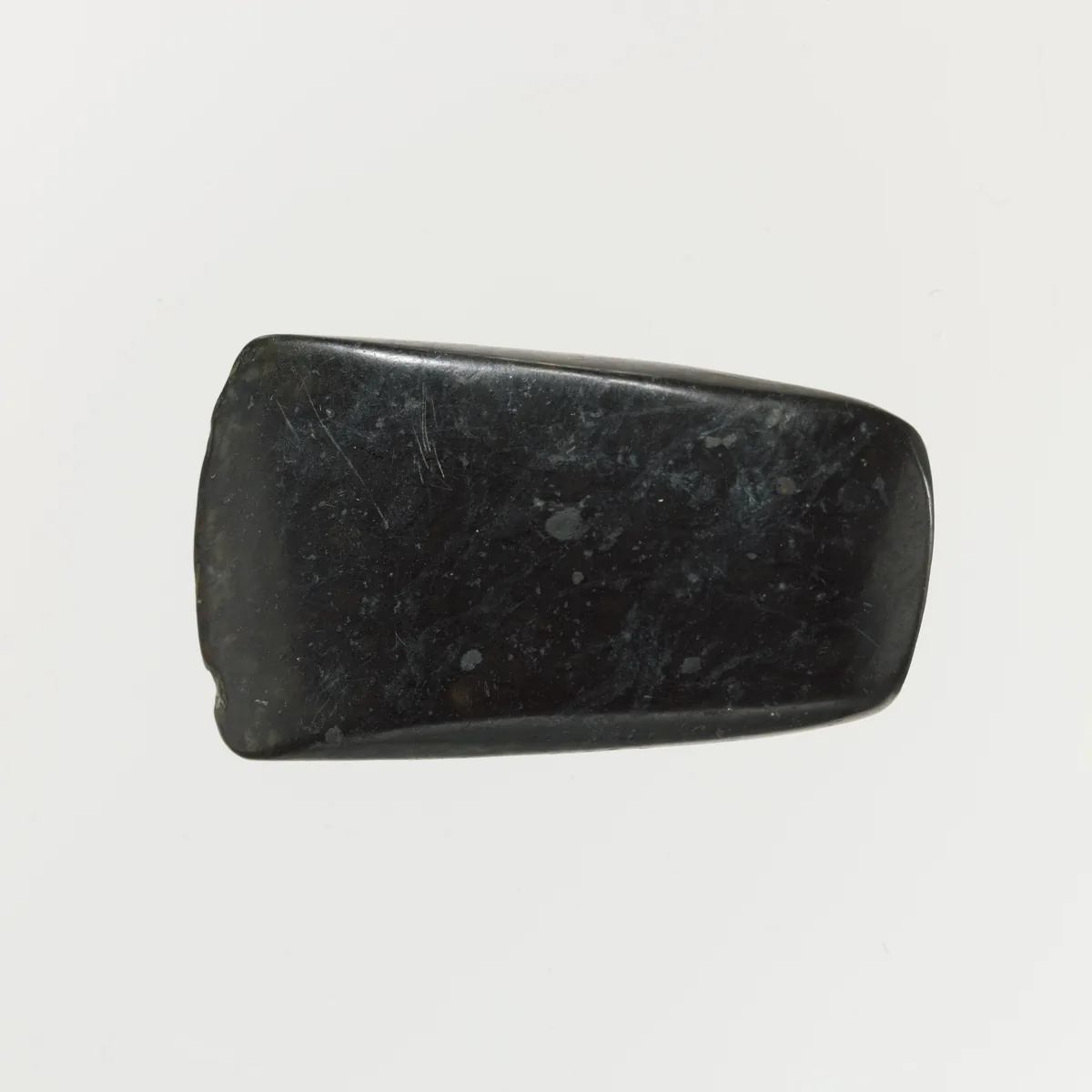
A polished stone tool less than five centimetres long, which the record describes in one word: "celt". A Neolithic object from Crete that recalls how long the Neolithic is outside the Levant too.
A small silver figure of a robed bull holding a spouted vessel, dated by the museum about 3100-2900 BCE and attributed to Proto-Elamite culture. The record gives "Southwestern Iran" but no findspot, and the museum itself writes that its function "remains uncertain".
ca. 3100-2900 BCE
Text frame in place of a photograph
Silver6 7/16 x 2 1/2 x 4 1/4in. (16.3 x 6.3 x 10.8cm)
The source has an openly licensed image; it is not included here yet
A small gypsum alabaster figure of a worshiper with clasped hands and a wide-eyed gaze, 29.5 cm high, which according to the museum was placed in the "Square Temple" at Tell Asmar. The record dates it about 2900-2600 BCE, to Early Dynastic I-II.
ca. 2900-2600 BCE
Text frame in place of a photograph
Gypsum alabaster, shell, black limestone, bitumen11 5/8 x 5 1/8 x 3 7/8 in. (29.5 x 12.9 x 10 cm)
The source has an openly licensed image; it is not included here yet
A marble figure of a woman, 62.79 cm high, which the museum attributes to the "Bastis Master" and dates 2600-2400 BCE, Early Cycladic II. The record names no findspot and no island: the figure is placed on the timeline by date, culture and style only.
2600-2400 BCE
Text frame in place of a photograph
MarbleH. 24 3/4 in. (62.79 cm)
The source has an openly licensed image; it is not included here yet
A small clay tablet and its sealed case, "probably from Kültepe (Karum Kanesh)", of the 20th-19th century BCE. The tablet records the discharge of a debt for a silver loan owed to Ashur-taklaku, and the case bears impressions of four different seals.
A painted wooden model of a single workshop in which bread is baked and beer brewed in separate rooms. It was found in 1920 in a hidden chamber of Meketre's tomb at Thebes, one of twenty-four almost perfectly preserved models.
ca. 1981-1975 BCE
Text frame in place of a photograph
Wood, gesso, paint, linenl. 73 cm (28 3/4 in); w. 55 cm (21 5/8 in); h. 29 cm (11 7/16 in); average height of figures: 21 cm (8 1/4 in.)
The source has an openly licensed image; it is not included here yet
A one-centimetre amulet of glazed faience found in the debris of a tomb at Lisht South. The record documents an exact findspot and a display in Gallery 109; what it lacks is an open photograph.
A blue faience hippopotamus figurine found in a shaft associated with the tomb chapel of Senbi II at Meir. Three of its legs have been restored: according to the museum, they were probably broken on purpose, so that the animal could not harm the deceased.
ca. 1961-1878 BCE
Text frame in place of a photograph
FaienceL. 20 cm (7 7/8 in.); W. 7.5 cm (2 15/16 in.); H. 11.2 cm (4 7/16 in.)
The source has an openly licensed image; it is not included here yet
A small clay jug with white decoration, dated to the Middle Cypriot period. In the site's period scheme for Cyprus it is placed in the Middle Bronze Age, by the period name in its record.
A small seal-amulet of glazed steatite that the museum records "From Canaan, Levant" and dates by an Egyptian dynasty. Place, dating scheme and culture are three separate questions here.
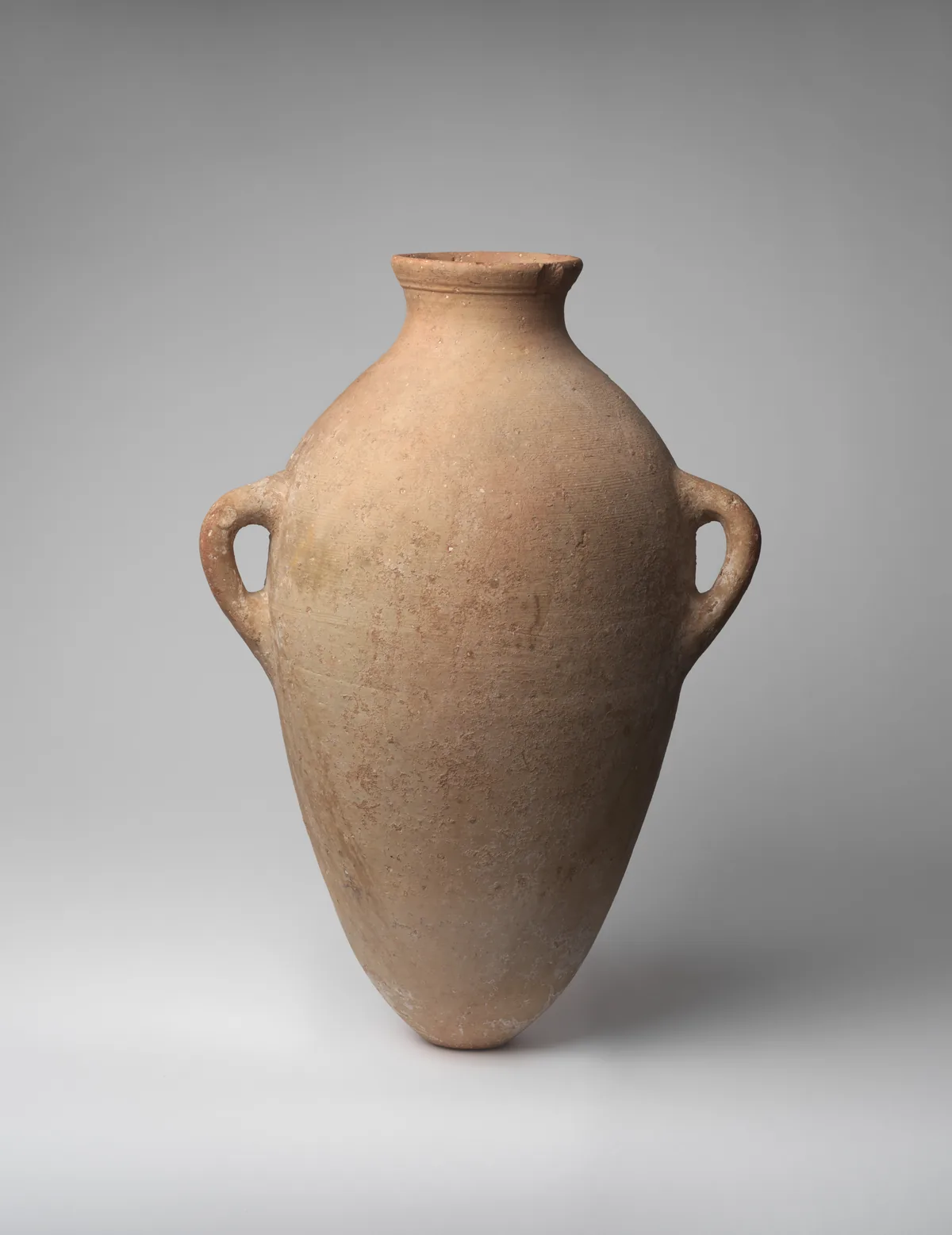
A large Late Bronze Age clay jar that the museum records as "Canaanite" and "Levant" with no findspot. A pointed base and two handles: a form made for storage and transport, which says something about the vessel before anyone knows where it came from.
A silver drinking vessel with gold inlay, ending in the forepart of a stag, which the museum dates ca. 14th-13th century BCE and assigns to the Hittite Empire. Its rim frieze shows a religious ceremony; its findspot is not recorded.
An uninscribed limestone figurine found in the tomb of Sennedjem at Deir el-Medina in the excavations of 1885-86. The museum dates it to the reign of Ramesses II and displays it in Gallery 126.
A clay chest-shaped coffin with its lid, recorded as one object (1996.521a, b) and dated by the museum to the "mid-13th century BCE", Late Minoan IIIB. The record gives no findspot: "Minoan" and "Crete" come from the type and the catalogue, not from an excavation.
mid-13th century BCE
Text frame in place of a photograph
TerracottaOverall with lid 40 x 18 x 42 1/4 in. (101.6 x 45.7 x 107.3 cm); H. of body 30 1/2 in. (77.5 cm); H. of lid 9 1/2 in. (24.1 cm)
The source has an openly licensed image; it is not included here yet
A leaf-shaped blade with a pronounced midrib and a socket with two rivet holes. The record even describes the fabric impression left on the socket; what it lacks is a findspot.
A small terracotta tripod that the museum dates to about 1050-950 BCE, "Cypro-Geometric I". Two of its three legs carry human figures, and the museum links its decoration to bronze stands made on Cyprus at the very end of the Bronze Age.
ca. 1050-950 BCE
Text frame in place of a photograph
TerracottaH. 7 in. (17.8 cm); diameter 5 13/16 in. (14.7 cm)
The source has an openly licensed image; it is not included here yet
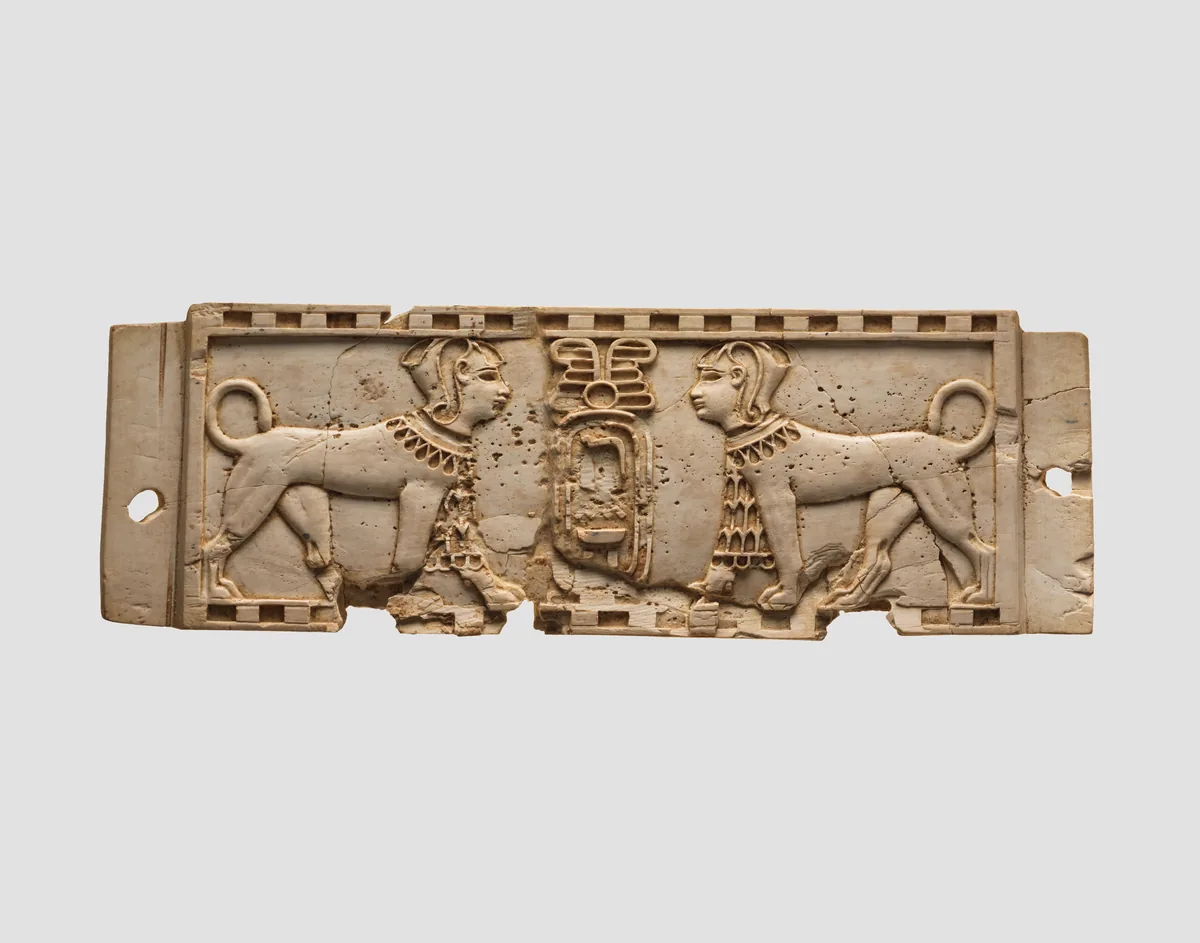
An ivory furniture plaque excavated in 1962 at Fort Shalmaneser, Nimrud: two sphinxes flanking a cartouche. The record attributes the style to the Phoenician and notes that none of the inlays survived.
A panel of glazed bricks with a striding lion, dated by the museum ca. 604-562 BCE, the reign of Nebuchadnezzar II. According to the record, such lions lined Babylon's Processional Way north of the Ishtar Gate; the exact position of this panel is not stated.
A Cypriot vessel, a Phoenician inscription and a findspot nobody recorded: one object that teaches us to separate what is written on it from where it came from.
A marble statue almost two metres high that the museum describes as one of the earliest marble statues of a human figure carved in Attica. It marked the grave of a young Athenian aristocrat and is dated ca. 590-580 BCE.
ca. 590-580 BCE
Text frame in place of a photograph
Marble, Naxian76 5/8 × 20 5/16 × 24 7/8 in. (194.6 × 51.6 × 63.2 cm); height without plinth 76 5/8 in. (194.6 cm); height of head 12 in. (30.5 cm); length of face 8 7/8 in. (22.6 cm); shoulder width 20 5/16 in. (51.6 cm)
The source has an openly licensed image; it is not included here yet
A bronze lampstand 65.4 cm high, which the museum dates to the late 6th century BCE and assigns to Cypriot culture and the Archaic period. No findspot is given, and the record describes how this kind of object was used, not this lampstand.
late 6th century BCE
Text frame in place of a photograph
BronzeH. 25 3/4 in. (65.4 cm)
The source has an openly licensed image; it is not included here yet
A small gold coin of the Achaemenid empire, assigned by the museum to Iran and dated to the fourth century BCE. The figure is a "king" per the record's title; more than that the record does not say.
A turquoise-green glass jug 9.5 cm high, blown in a four-part mold. The record documents the mold seams on the vessel but does not say where the jug came from; it is therefore recorded in the region "place not stated".
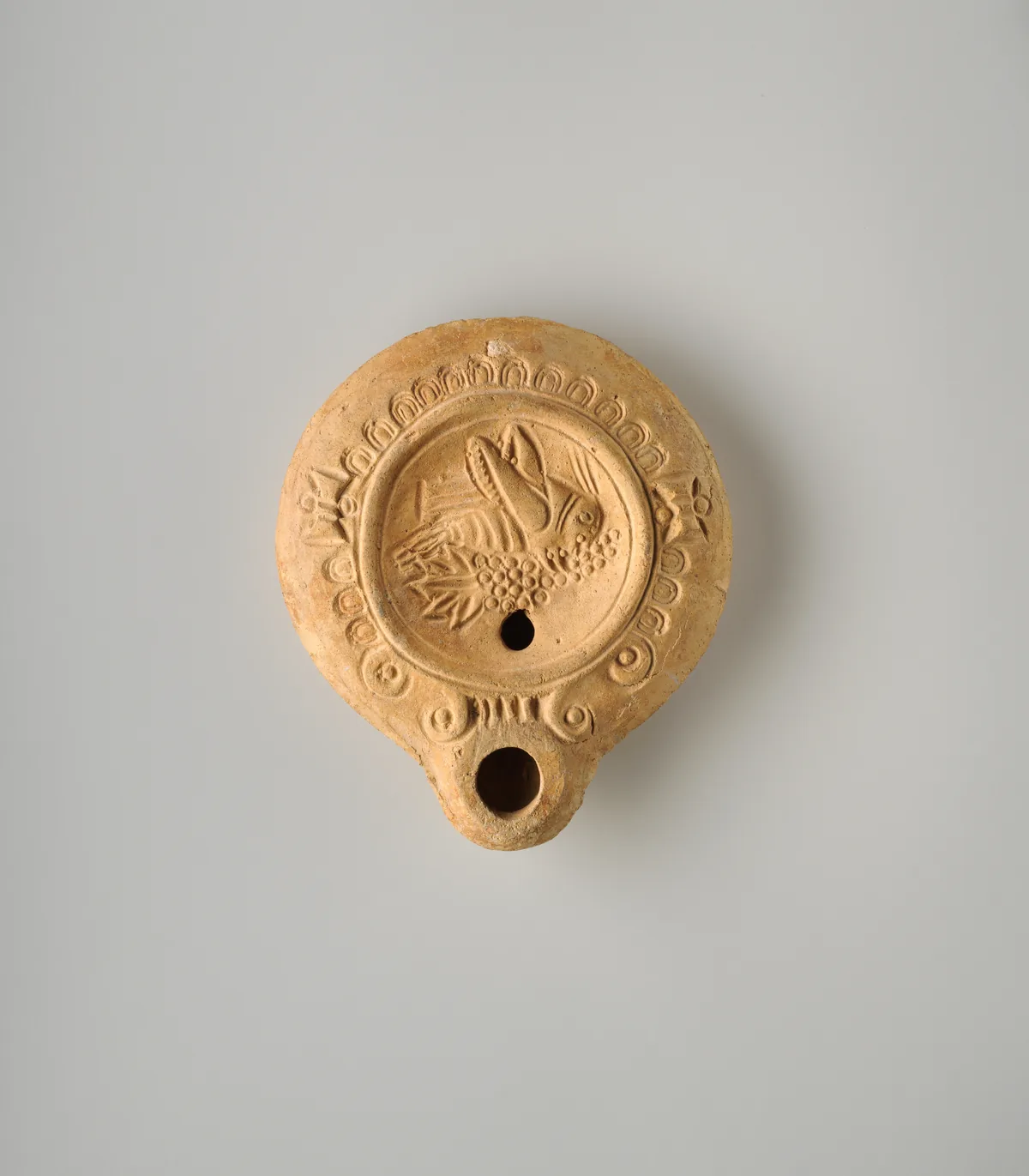
A small mold-made lamp with a locust eating grapes on the discus. The record proposes "probably Syria-Palestine" as the place of manufacture, not a findspot.
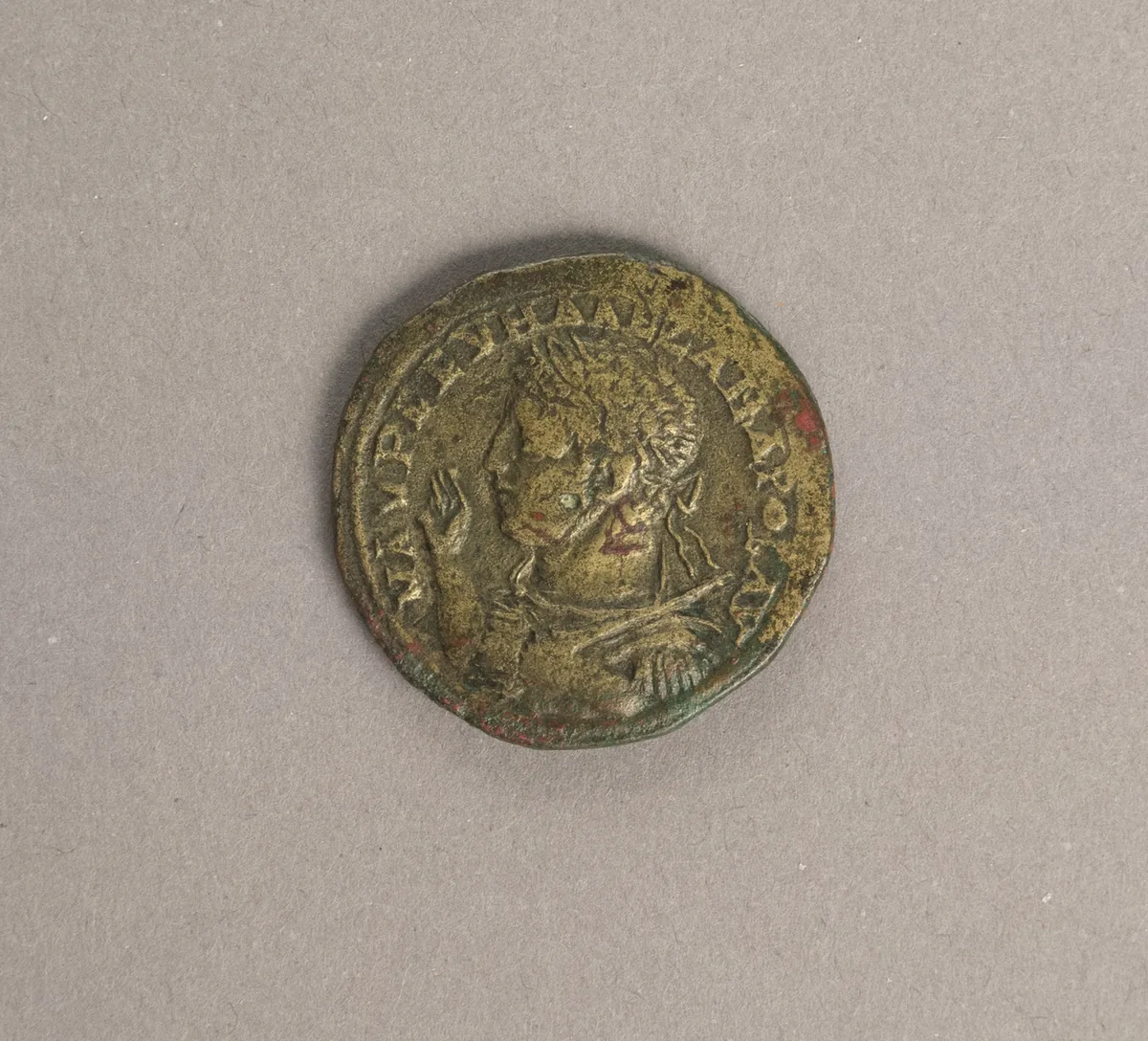
A Roman civic coin from Asia Minor: a bust of Alexander Severus on one side, a table with imperial busts and sacrificial implements on the other. The coin that accompanies the article on coins and hoards as a comparison, not as a coin from the hoard.
A small blue-green glass jug with blue trails around the rim and neck. The record gives a three-century range that crosses the site's boundary between "Roman" and "Byzantine", so the jug is not placed on the timeline.
A gilded Sasanian silver plate that the museum dates to about the mid-5th to mid-6th century CE. The king's identity is uncertain, and the findspot is known only from what was "said" at the time of acquisition.
ca. mid-5th-mid-6th century CE
Text frame in place of a photograph
Silver, mercury gilding, niello inlayH. 1 7/8 in. (4.6 cm), Diam. 8 5/8 in. (21.9 cm)
The source has an openly licensed image; it is not included here yet
A six-sided glass jug shaped in a mould and dated 500-650. The museum calls it a vessel "of the Jerusalem type" but says nothing of where it was made or found, so it is shown by its source date only.
A wheel-shaped window of stucco, decorated on one side only, found in pieces at the house Ma'aridh II in the Ctesiphon area. The museum dates it ca. 6th century CE and sees in it evidence of an exchange of artistic ideas between Mesopotamia and the eastern Mediterranean.
ca. 6th century CE
Text frame in place of a photograph
Stucco24 1/2 in., 80 lb. (62.2 cm)
The source has an openly licensed image; it is not included here yet
A fragment of a wall painting on stucco, 9th-10th century, found in the drain of a house in the Sabz Pushan neighbourhood of Nishapur. The record names no period, so it is placed by its date range.
9th-10th century
Text frame in place of a photograph
Stucco; paintedH. 9 1/2 in. (24.1 cm), W. 10 1/4 in. (26 cm); mount: H. 11 in. (27.9 cm), W. 10 5/16 (26.2 cm)
The source has an openly licensed image; it is not included here yet
A gold and glass centrepiece of a necklace with a pair of birds on a crescent, which the museum attributes to Syria and dates to the 11th century. A northern attribution and a date that runs up to the 1099 boundary: the object is not assigned to a period.
11th century
Text frame in place of a photograph
Gold, glassH. 2 5/16 in. (5.8 cm); W. 1 5/16 in. (3.4 cm); D. 1/4 in. (0.6 cm); Wt. 0.4 oz. (11.3 g)
The source has an openly licensed image; it is not included here yet
An oval brass box inlaid with silver, which the museum attributes to Syria and dates to the 15th century. The record disagrees with itself: by one description the box was commissioned for a mosque official, by another Muhammad al-Hamawi was the artist who made it.
15th century
Text frame in place of a photograph
Brass; engraved and inlaid with silverH. 4 in. (10.2 cm); W. 6 11/16 in. (17 cm); D. 3 1/4 in. (8.3 cm)
The source has an openly licensed image; it is not included here yet
A figurine of a nude man carved in hippopotamus ivory, found in 1958 in a cache in room 721 at Beersheba. The Louvre's record gives it two dates that do not agree, the 5th millennium BCE and 3500-3000 BCE, so it is not placed on the timeline.
5th millennium BCE or 3500-3000 BCE (record conflicts)
A sherd of a pottery vessel with a Hebrew inscription in ink, found at Lachish and on display today in London. The ink is very faded, the record gives no numeric date, and it must not be confused with Letter II.
Iron Age; no numeric date in the record
Text frame in place of a photograph
PotteryLength 6.40 cm; width 9.50 cm; thickness 0.30-0.50 cm
The source states no licence for its image, so it is not reproduced here
A small merchant ship discovered in 1985 off the Carmel coast, conserved for years and displayed today at the Hecht Museum. The date "about 400 BCE" is the museum's; the placement in the Persian period is ours.
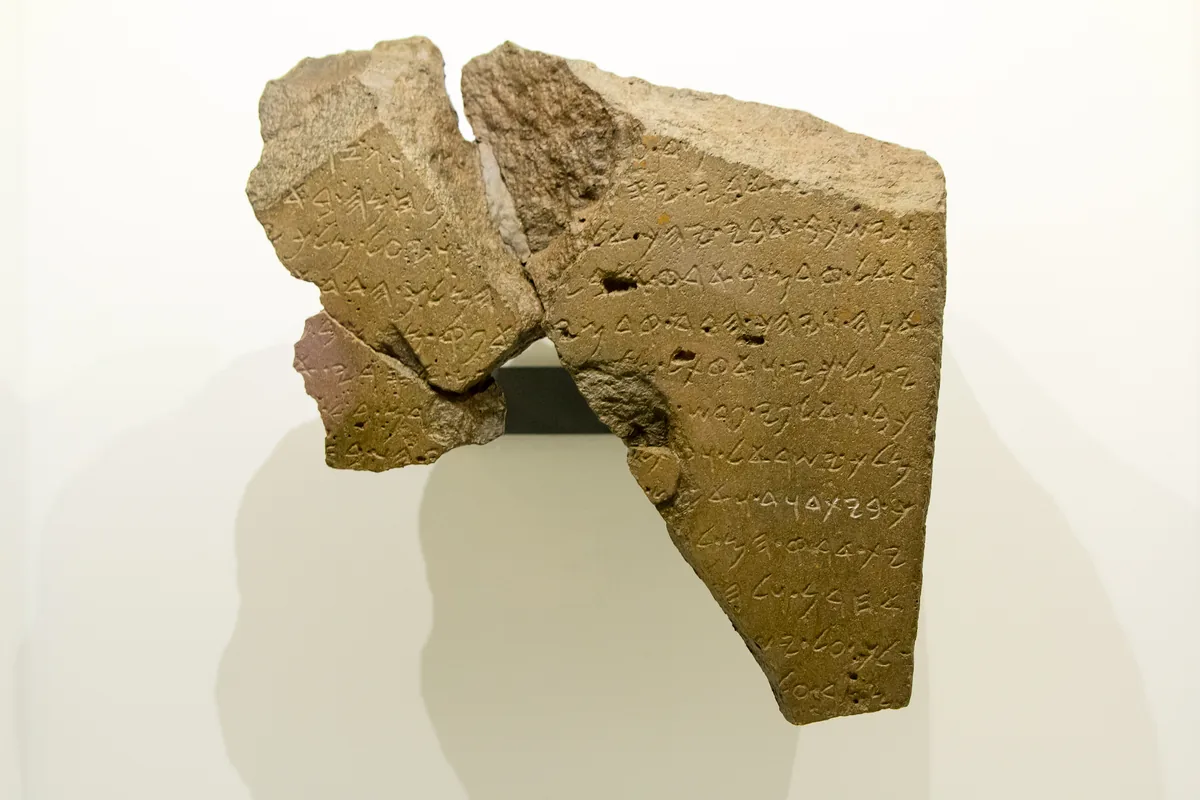
A fragment of a basalt stele with an Aramaic inscription, found at Tel Dan and held by the Israel Museum. The photograph here is a visitor's photograph from a temporary exhibition at the Bible Lands Museum in 2017 (CC BY-SA 4.0), not the record's image; the museum's own image is seen in the record.
A wooden boat exposed in 1986 on the bed of the Sea of Galilee, conserved for 14 years and displayed at the Yigal Allon Centre. The centre dates it "some 2,000 years ago": a wording without a range, so the boat is not placed on the timeline.
“some 2,000 years ago”, per the centre
Reading, accessibility & privacy tools
Adjust the reading experience to suit you. These tools complement your browser and device accessibility settings. Changes apply to this page; they are kept for another visit only if you allowed that in the privacy dialog.
Your choices apply to this page only. Moving to another page restores the defaults.