The photograph could not be loaded
Documented object · Inscriptions
The Tel Dan stele: "House of David"
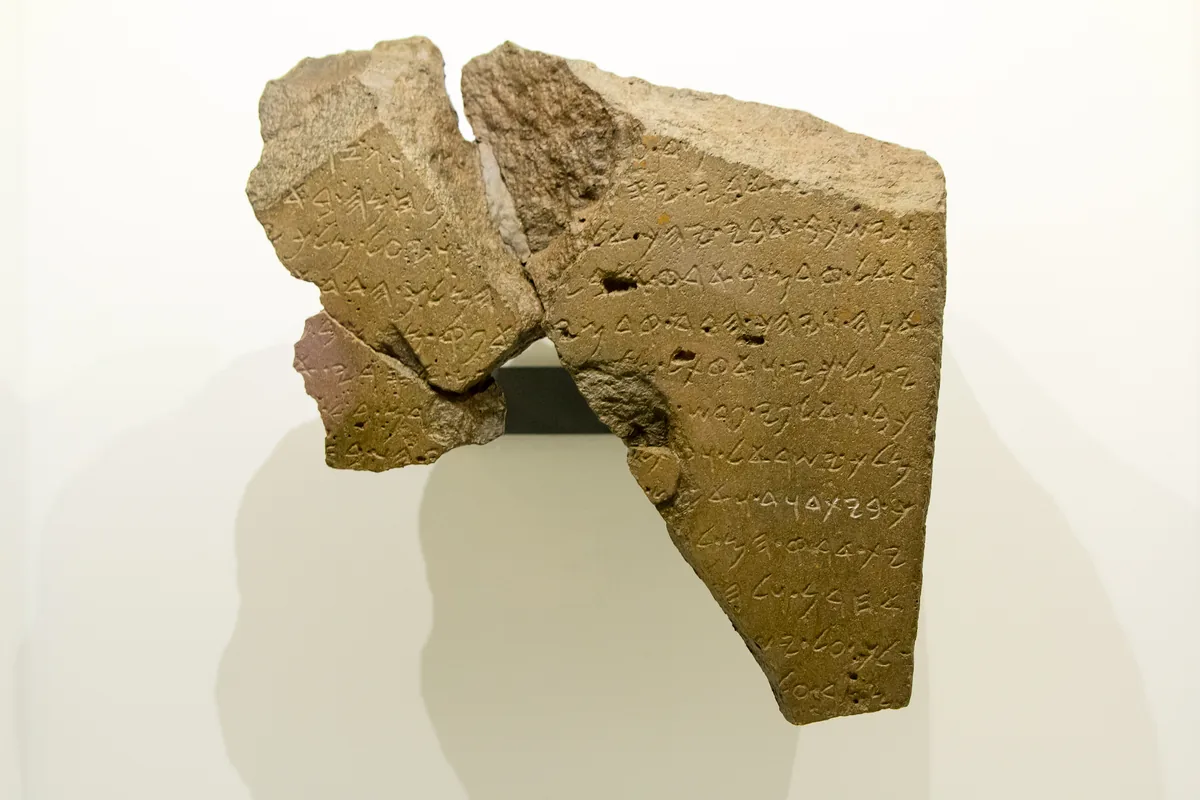
A fragment of a basalt stele with an Aramaic inscription, found at Tel Dan and held by the Israel Museum. The photograph here is a visitor's photograph from a temporary exhibition at the Bible Lands Museum in 2017 (CC BY-SA 4.0), not the record's image; the museum's own image is seen in the record.
Date as given by the source9th century BCE (Iron Age II)As worded by the source: Iron Age II, 9th century BCE
What you see
What the object is
A fragment of a basalt stele, 34 cm high and 32 cm wide, carrying an inscription in Aramaic script. The record dates it "Iron Age II, 9th century BCE" and gives Dan as the findspot. Source 1.
About the photograph here
The museum record shows the photograph of the stele with the note "Photo © The Israel Museum, Jerusalem" and "Request permission to use this image". The museum's photograph is not reproduced here. The photograph on this page was taken by Oren Rozen at a temporary exhibition at the Bible Lands Museum, Jerusalem, in February 2017 and is licensed CC BY-SA 4.0 (Wikimedia Commons): a record of the stele as it was displayed then, not the record's image, and no indication of where the stele is shown today. The authoritative image of the stele remains the museum's own; the credit and licence of the photograph here appear beneath it.
How the record was read
The values on this page, findspot, dating, material, dimensions and registration numbers, are quoted from the Israel Museum's collection record as read on 21 October 2026, which is therefore also the verification date of the period placement. The official record is the binding source and may be updated; anyone relying on a particular value should consult it.
What the text says
The record includes a translation of the inscription; this page neither quotes it nor offers a reading of its own. The name "House of David" in the title is the name by which the stele is known, a reading of the inscription to be checked in the editions and the scholarly discussion, not a fact this page establishes. The article on reading ancient inscriptions explains the separation of transcription, restoration and translation.
Its place on the timeline
"Iron Age II" is a subdivision of the Iron Age, defined on the site as 1200 to 586 BCE. The placement here is "per the museum".
Where it is now
The stele is held by the Israel Museum in Jerusalem. The record as observed included no display-status field, so this page does not claim that it is on display; check the museum's site before a visit.
The object's connections
The object's connections
Culture, period, place, type and holder: every connection comes from the record or a cited source.
Object
The Tel Dan stele: "House of David"
Period
- The Iron AgePer the museum
Region
Kind of find
On the trail
Source
Sources and further reading
The research and references behind this page. Rights to external content remain with their owners.
- 1
Tel Dan stele ("House of David" inscription), Israel Museum collection record 371407-0
The Israel Museum, Jerusalem · Checked
- 2
The Eastern Mediterranean and Syria, 1000 B.C.-1 A.D.
The Metropolitan Museum of Art · 2000 · Checked