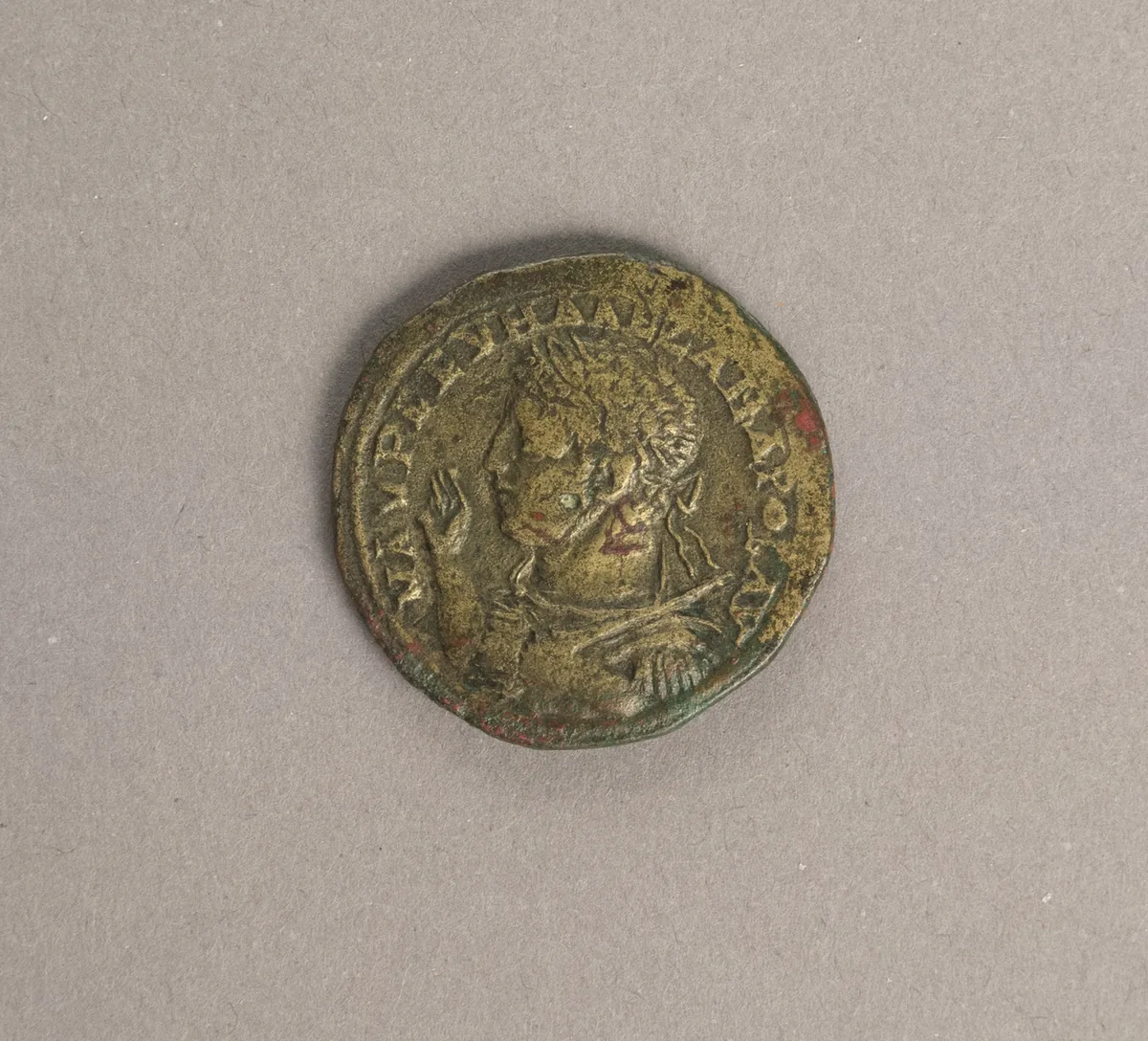
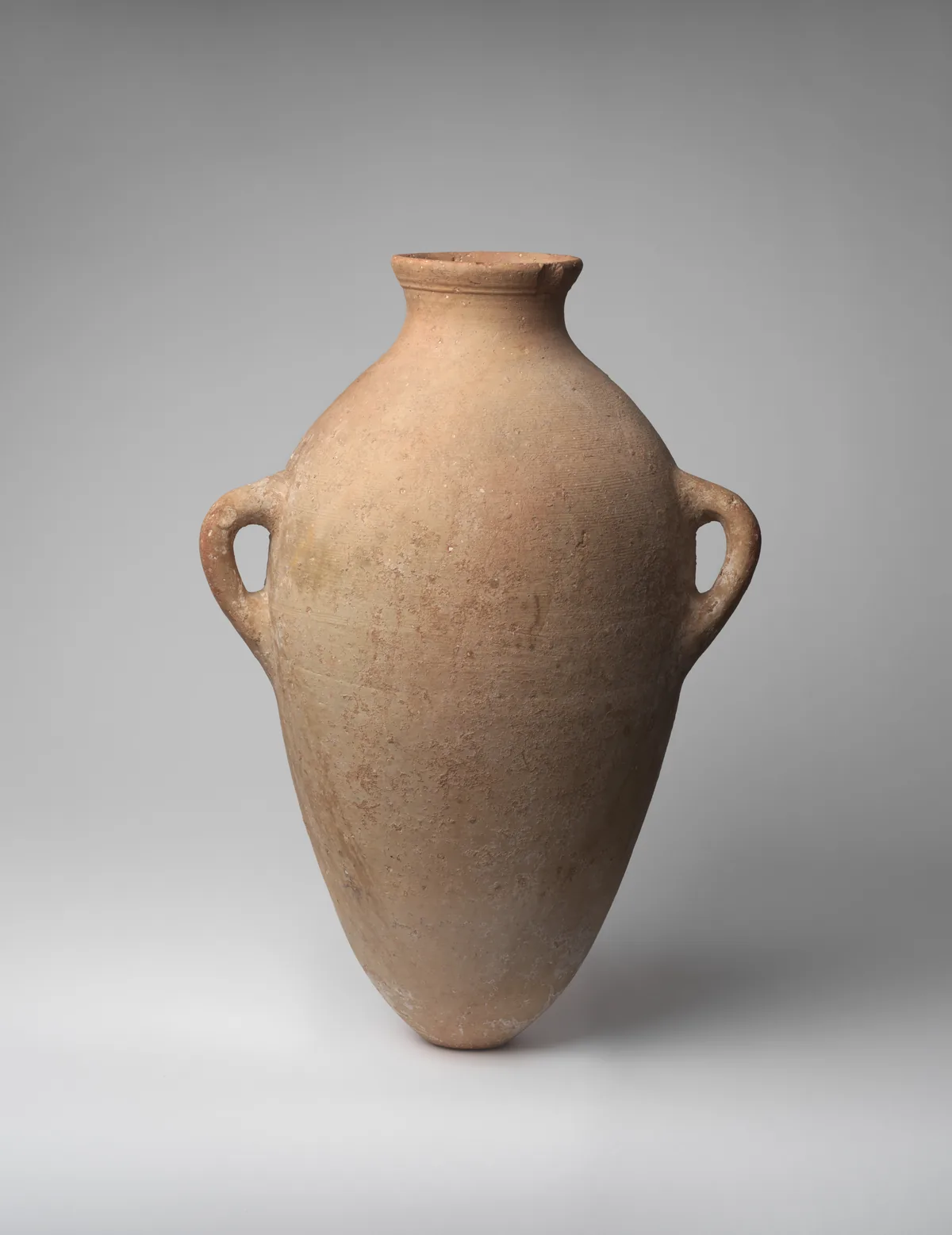
Reading trail
Light and glass at home
Daily life through three vessels: a terracotta oil lamp and two glass jugs, from the first to the sixth century CE, then the method and the village. Five steps.
Passes through Roman terracotta oil lamp.
PERIODS · The Levant
Houses and inscriptions offer starting points for reading everyday life. This route focuses on studies of the Early Roman period.
Approximately 64 BCE-330 CEMove through the periods
The whole scheme with this period marked; the periods before and after are its neighbours in the row. Boundaries follow the sources and are not to scale.
Objects
The photograph could not be loaded
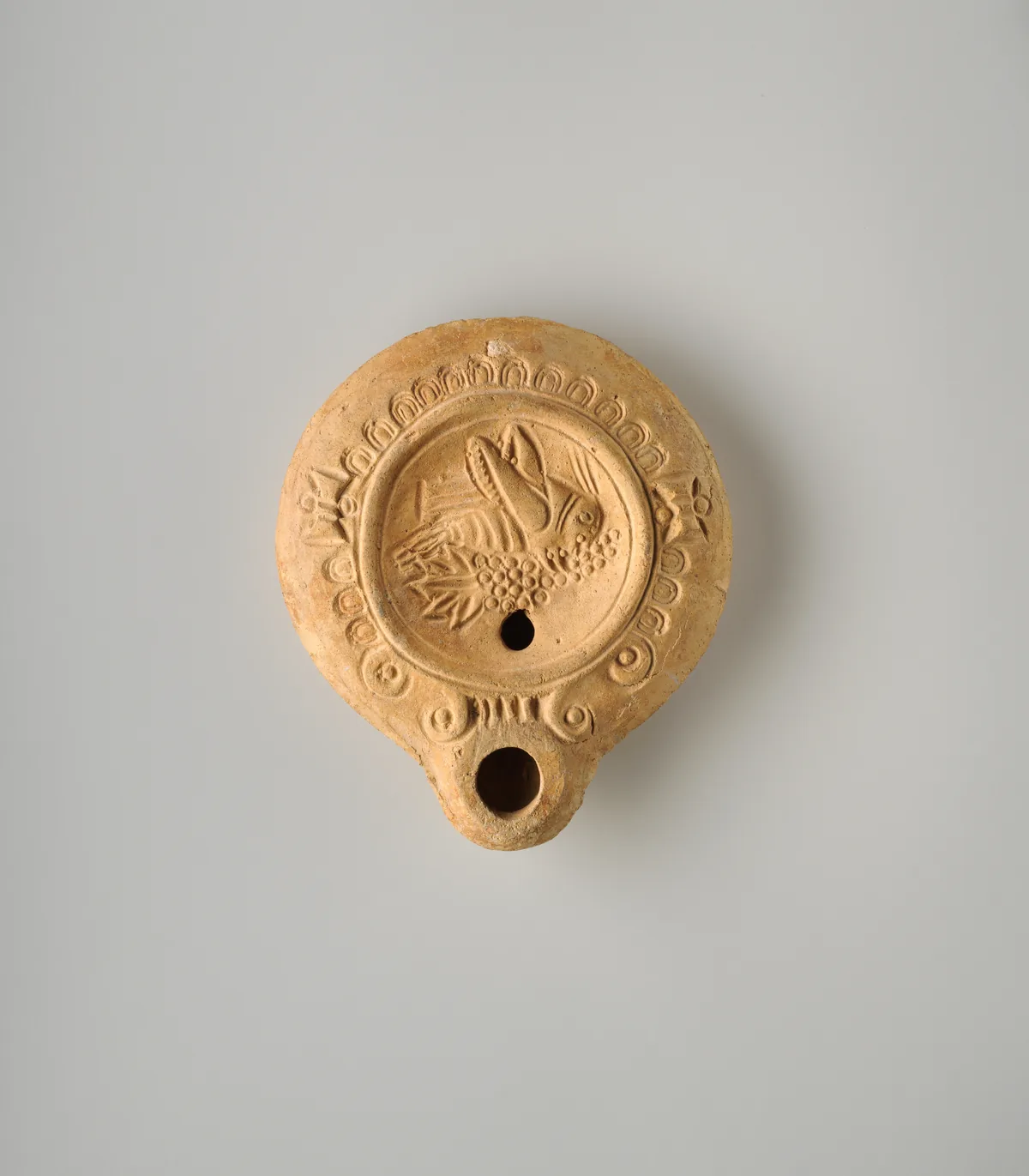
Object · ca. 90-200 CE
A small mold-made lamp with a locust eating grapes on the discus. The record proposes "probably Syria-Palestine" as the place of manufacture, not a findspot.
Dated to this period by its source record.
Open the objectThe examples focus on the Early Roman period and, at Nazareth, the transition from the late Hellenistic period. This page does not propose new boundaries for the entire Roman period; use each cited study’s definition for precise dating.
The Nazareth article offers a way to read built space and layers. The Jerusalem inscription article examines the move from identifying marks to proposing a function. Read together, they allow comparison between different kinds of evidence without assuming identical ways of life in both places.
When you meet the label “Roman”, check whether it describes a date, political context, style or workshop attribution. Write down the source’s explanation alongside the label. If none is available, keep the question open.
The lamp photograph is a comparative museum object identified in its caption. It is not a find from the Nazareth excavation. The library keeps that distinction between a visual example and evidence from a particular site.
When an object is called “Roman”, establish what that label communicates: a date, a political territory or a manufacturing tradition. It should not automatically become the user's identity. A lamp, coin and inscription may occur together while answering entirely different questions.
A coin carries information selected at minting, but its excavated position concerns a later stage in its life. A lamp permits study of form and wear without identifying the language spoken beside it. An inscription supplies words but may be fragmentary or reused. Strong interpretation combines these forms of evidence without making one speak for all the others.
The Nazareth article and Jerusalem page support comparison between different scales of activity. This is not a competition for importance: ask what was exposed, how material was recovered and what remains unexamined. One house can reveal its plan in detail while remaining insufficient evidence for an entire settlement. A rare urban object is likewise not a representative sample of all residents.
Our timeline gives approximately 64 BCE-330 CE, following regional source 3. Other boundaries are used for local sequences and the Roman-Byzantine transition. This is not a claim that every material tradition ended in one year. Read the framework alongside each find's own dating. Moving into the next period continues the enquiry into object lives rather than presuming an automatic interruption.

Source
The research and references behind this page. Rights to external content remain with their owners.
Yardenna Alexandre · 2020 · Checked
Research record in this libraryEsther Eshel, Nahshon Szanton · 2023 · Checked
Research record in this libraryThe Metropolitan Museum of Art · 2000 · Checked
Articles
RESEARCH & METHOD
Why a minting date differs from a burial date, and why a hoard is not a simple snapshot of money in circulation. Museum examples and the Qula case explain the distinction.
Architecture · Levant
In the Met's timeline, under the year 326 CE, Helena, mother of the emperor Constantine, founds the Church of the Nativity in Bethlehem. What that sentence says about imperial building at the holy sites, and what it does not.
INSCRIPTION · JERUSALEM
A short inscription opens a larger question about everyday life: how do we distinguish the surviving text from its proposed function?
READING JOURNEY · SIX PERIODS
Six finds, six periods of the site's Levant scheme, one source per stop. The bar above the text marks where you are on the timeline as you read.
READING A FIND · NAZARETH
What can a small excavation tell us about settlement, and why do successive layers not necessarily mean uninterrupted occupation?
Continue from here
Every card comes from a documented relation or an editorial link. The reason line explains the connection.
PERIOD GUIDE
Explore Byzantine chronology through Jerusalem, a glass jug and an anchor from the Carmel coast, while separating finds from the comparisons used to explain them.
The period that followed.
PERIOD GUIDE
How to compare vessels, writing and buildings without assuming that people’s identities change whenever object styles do.
The period that came before.
Adjust the reading experience to suit you. These tools complement your browser and device accessibility settings. Changes apply to this page; they are kept for another visit only if you allowed that in the privacy dialog.
Your choices apply to this page only. Moving to another page restores the defaults.