Reading trail · 5 steps
Light and glass at home
Daily life through three vessels: a terracotta oil lamp and two glass jugs, from the first to the sixth century CE, then the method and the village. Five steps.
The photograph could not be loaded
Three objects someone used at home: to light, to pour, to keep. None of them has a findspot in its record, so the trail does not tell of a particular house; it shows what can be read from the object itself (technique, material, form) and what needs the context of an excavation. The last steps bring that context.
The steps
-
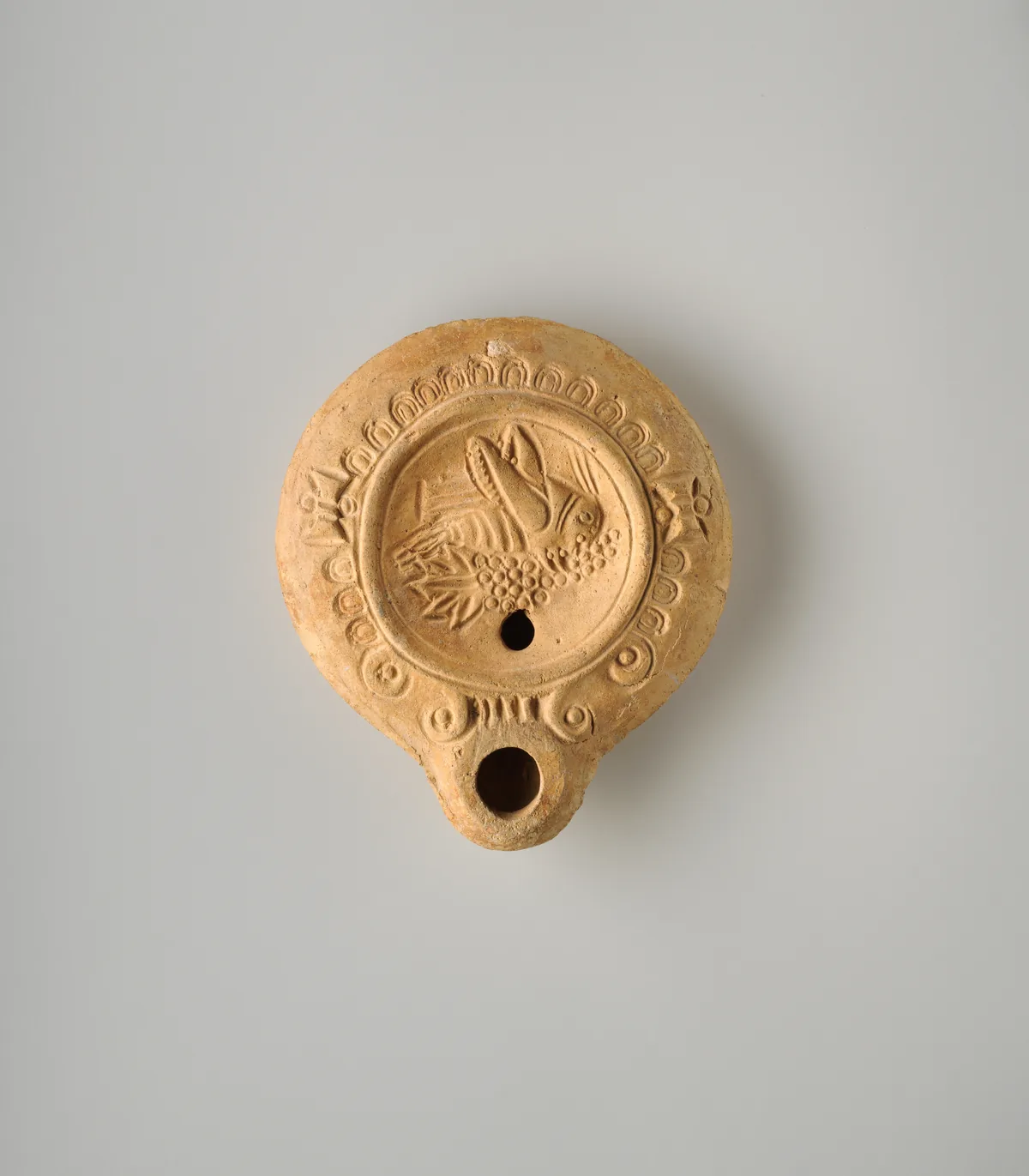
Detail of the photograph: Roman terracotta oil lamp Discus: a locust eating grapes.The Metropolitan Museum of Art · 74.51.2256 · The Cesnola Collection, Purchased by subscription, 1874-76 · CC0 · Source · CC0 1.0 Step 1 · Object
Roman terracotta oil lamp
A small mold-made lamp with a locust eating grapes on the discus. The record proposes "probably Syria-Palestine" as the place of manufacture, not a findspot.
Open this stepWhy this step
An everyday object made in a mold: a terracotta oil lamp the record dates to the first to second century CE. The first step asks what a mass-made object says about a home, and what it cannot say without a findspot.
-

The photograph could not be loaded
Photograph of the object Roman glass jug blown in a four-part mold, first half of the first century CE. A museum comparison for manufacturing techniques, not from the Nazareth excavation. The Met, 12.212.3.The Metropolitan Museum of Art · 12.212.3 · Rogers Fund, 1912 · CC0 · Source · CC0 1.0 Step 2 · Object
Roman mold-blown glass jug
A turquoise-green glass jug 9.5 cm high, blown in a four-part mold. The record documents the mold seams on the vessel but does not say where the jug came from; it is therefore recorded in the region "place not stated".
Open this stepWhy this step
Mold-blown glass of the first century CE: a jug on which the mold seams are visible. A vessel that shows a technique one can identify by eye, even when the record does not say where it came from.
-

The photograph could not be loaded
Photograph of the object Glass jug, fourth-sixth century CE, attributed to Roman Syria. Collection comparison from The Met, 91.1.1361; no exact findspot is stated.The Metropolitan Museum of Art · 91.1.1361 · Edward C. Moore Collection, Bequest of Edward C. Moore, 1891 · CC0 · Source · CC0 1.0 Step 3 · Object
Syrian glass jug with cobalt trails
A small blue-green glass jug with blue trails around the rim and neck. The record gives a three-century range that crosses the site's boundary between "Roman" and "Byzantine", so the jug is not placed on the timeline.
Open this stepWhy this step
Four or five centuries later: a Syrian glass jug blown in a dip mold and trailed with cobalt threads. The comparison between the two jugs is between two records of the same museum, not a claim of continuity.
-

The photograph could not be loaded
Photograph of the object: Cypriot jug with white-painted decoration Decorated Cypriot pottery jug, ca. 1900-1800 BCE. A comparison from Cyprus, not a local excavation find. The Met, 74.51.1316.The Metropolitan Museum of Art · 74.51.1316 · The Cesnola Collection, Purchased by subscription, 1874-76 · CC0 · Source · CC0 1.0 Step 4 · OBJECT GUIDE · POTTERY
Pottery: from production to use and dating
What can a rim, handle or sherd tell us? Read pottery by connecting manufacture, use and the archaeological context of its discovery.
Open this stepWhy this step
From the objects to the method: how pottery is made, used and dated, and why an everyday vessel is sometimes the best evidence for the date of a layer.
Verified -
Detail of the photograph: Roman terracotta oil lamp The filling hole.The Metropolitan Museum of Art · 74.51.2256 · The Cesnola Collection, Purchased by subscription, 1874-76 · CC0 · Source · CC0 1.0 Step 5 · READING A FIND · NAZARETH
Nazareth: reading a settlement through its layers
What can a small excavation tell us about settlement, and why do successive layers not necessarily mean uninterrupted occupation?
Open this stepWhy this step
The ending in a village: an article that reads finds from an excavation at Nazareth and uses the oil lamp of the first step as a labelled comparison. This is what a home looks like when it has a findspot.
Per source 1 · Verified
End of the trail
End of the trail
From here, continue to an object, a period or another trail.
Back to the overviewSource
Sources and further reading
The research and references behind this page. Rights to external content remain with their owners.
- 1
Terracotta oil lamp, collection record 74.51.2256
The Metropolitan Museum of Art · Checked
- 2
Glass jug, collection record 12.212.3
The Metropolitan Museum of Art · Checked
- 3
Glass jug, collection record 91.1.1361
The Metropolitan Museum of Art · Checked