The photograph could not be loaded
What to look for in the photograph
What to look for in the photograph
Details the record or source describes; every point cites its basis.
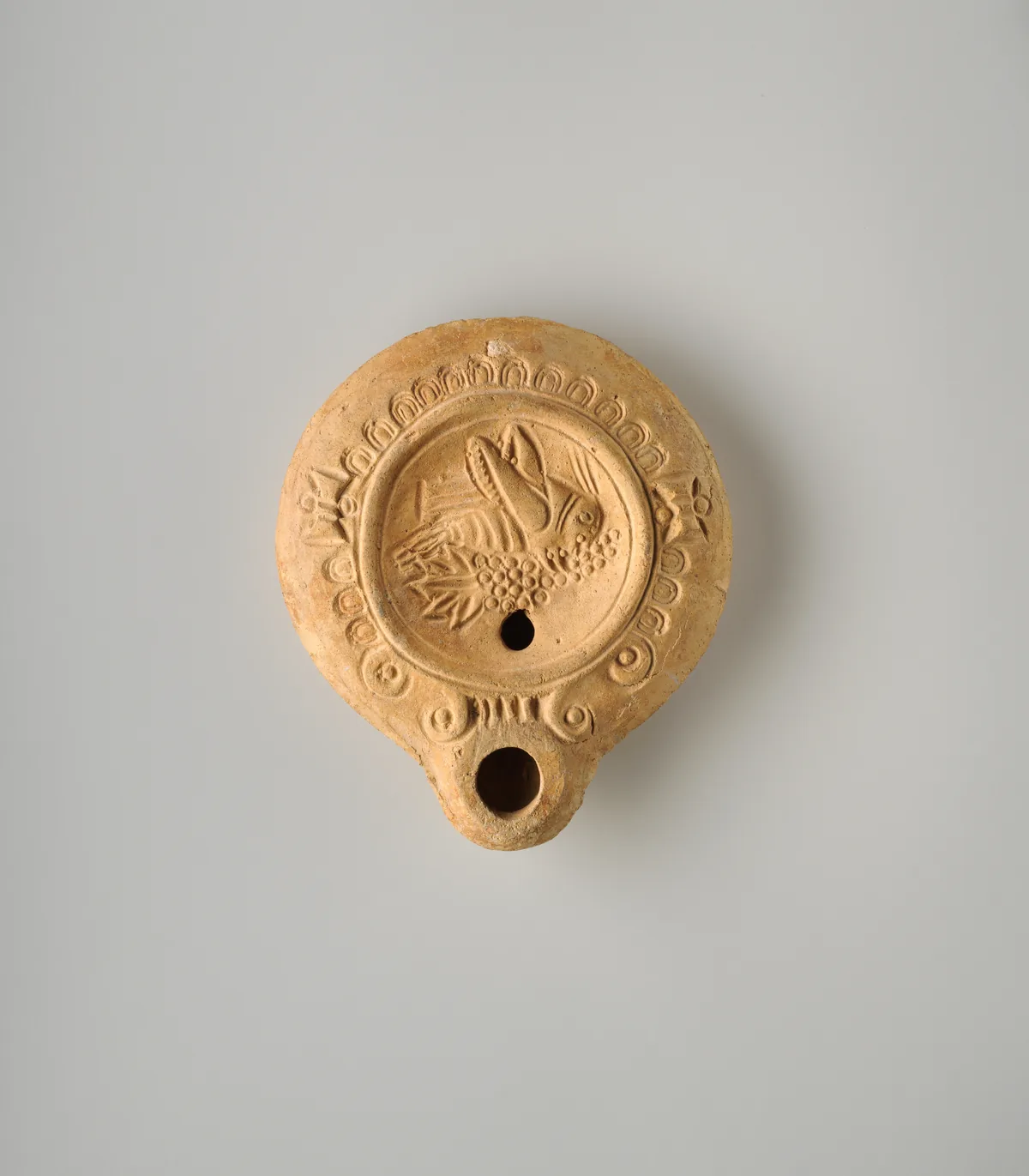
- 1 Discus: a locust eating grapes
The record describes on the discus "a locust facing right, eating grapes".
Per source 1 ·Discus: locust facing right, eating grapes
- 2 The filling hole
"A single filling hole at bottom" of the discus, per the record; the oil was poured through it.
Per source 1 ·a single filling hole at bottom
- 3 Shoulder: impressed ovules
A pattern of impressed ovules around the shoulder, "interrupted at the sides with two axe head-shaped designs".
Per source 1 ·On shoulder, a pattern of impressed ovules, interrupted at the sides with two axe head-shaped designs
- 4 Nozzle with volutes
"Stylized volutes flanking nozzle", per the record. The wick sat in the nozzle.
Per source 1 ·Stylized volutes flanking nozzle
Documented object · Pottery · Roman, per the catalogue; probable place of manufacture Syria-Palestine
Roman terracotta oil lamp
A small mold-made lamp with a locust eating grapes on the discus. The record proposes "probably Syria-Palestine" as the place of manufacture, not a findspot.
Date as given by the sourceca. 90-200 CEAs worded by the source: ca. 90-200 CE; Imperial
What you see
What you see
A small, shallow oil lamp, 8.4 cm across and 2.1 cm high, made in a mold. On the discus, the round surface at the centre, a locust facing right eats grapes; the shoulder carries impressed ovules and two axe-head designs. The lamp is intact. The base bears a two-letter Greek maker's mark. All these details come from the record's description. Source 1.
What the record says
The record dates the lamp "ca. 90-200 CE", assigns it to Roman culture and the Imperial period, and classifies it as Loeschcke Type 8. The probable place of manufacture is "Syria-Palestine", with the word "probably". The provenance field is empty and no findspot is given. The lamp is not currently on view.
Place of manufacture is not findspot
"Probably Syria-Palestine" is the catalogue's typological proposal about where the lamp was made, not documentation of where it was found. The lamp is therefore listed here in the Levant region on the strength of that proposal, and the findspot field stays empty. On this site it serves as a Roman-period comparison in the Nazareth article; it is not a find from the Nazareth excavation.
Its place on the timeline
The record's period name, "Imperial", is a general Roman label, not a Levant period name. The numeric range 90 to 200 CE lies entirely inside the site's Roman period (64 BCE to 330 CE), so the lamp is placed there "by its dating".
Where it is now
The lamp belongs to the Cesnola Collection, purchased by subscription in 1874-76, and is held by The Metropolitan Museum of Art, record 74.51.2256. On 22 October 2026 the record stated "Not on view".
The object's connections
The object's connections
Culture, period, place, type and holder: every connection comes from the record or a cited source.
Object
Roman terracotta oil lamp
Period
- The Roman period, up closeBy its dating
Region
Kind of find
On the trail
- Light and glass at homeStep 1
Source
Sources and further reading
The research and references behind this page. Rights to external content remain with their owners.
- 1
Terracotta oil lamp, collection record 74.51.2256
The Metropolitan Museum of Art · Checked
- 2
The Eastern Mediterranean and Syria, 1-500 A.D.
The Metropolitan Museum of Art · 2000 · Checked