The photograph could not be loaded
What to look for in the photograph
What to look for in the photograph
Details the record or source describes; every point cites its basis.
- 1 The portrait
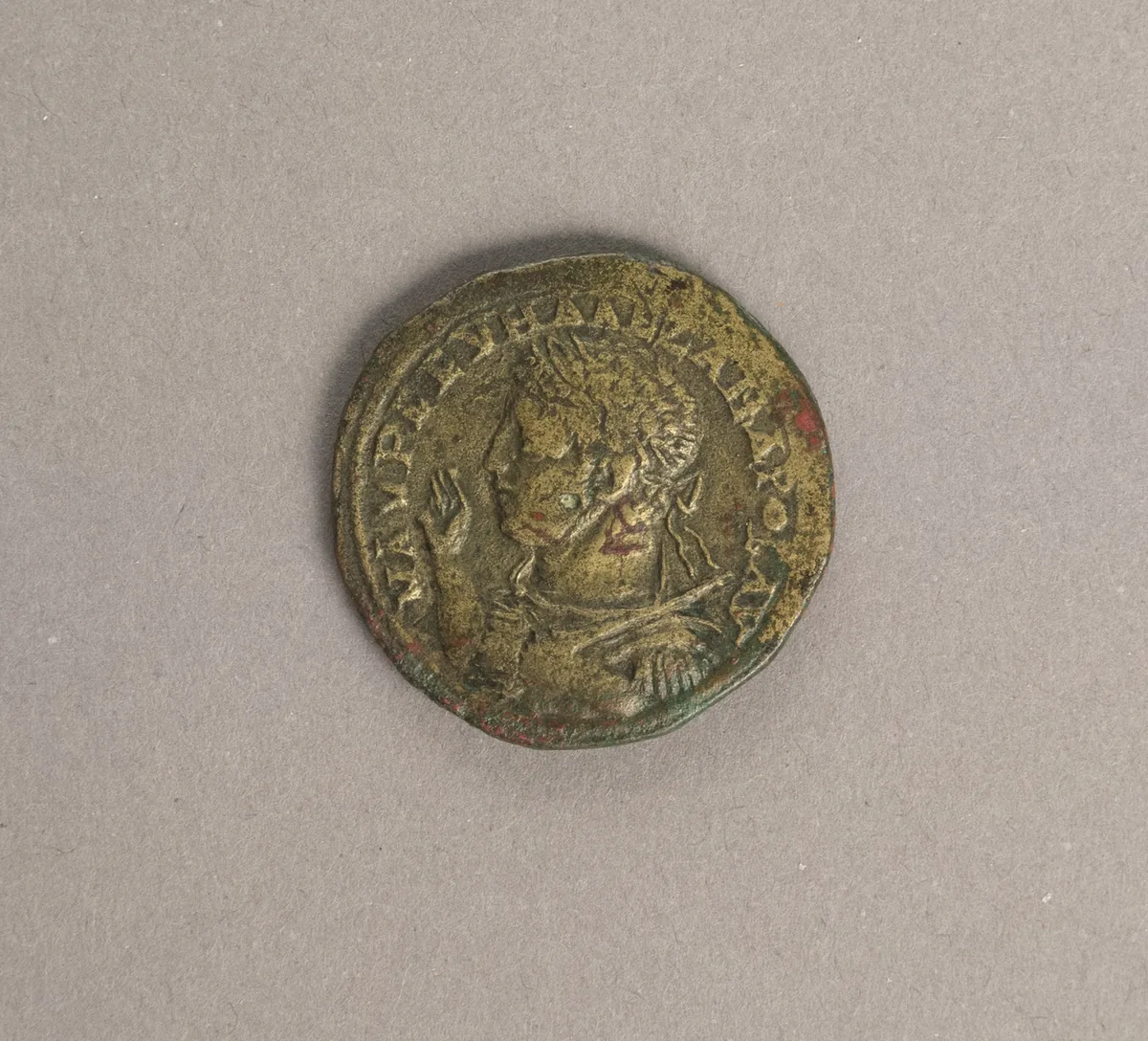
"Bust of Alexander Severus", per the record. The raised hand is visible in the photograph; the record does not describe it.
Per source 1 ·bust of Alexander Severus
- 2 The legend around the edge
The record reads the legend: M AVP CEVH ALEXANDROC AV, the emperor's name and titles in Greek.
Per source 1 ·M AVP CEVH ALEXANDROC AV
Documented object · Coins · Roman, Asia Minor, per the catalogue
Bronze coin of Cyzicus
A Roman civic coin from Asia Minor: a bust of Alexander Severus on one side, a table with imperial busts and sacrificial implements on the other. The coin that accompanies the article on coins and hoards as a comparison, not as a coin from the hoard.
Date as given by the source222-235 CEAs worded by the source: 222-235 CE; Mid Imperial, Severan
What you see
What you see
A bronze coin 2.8 cm across weighing 11.4 g. The record describes on one side a "bust of Alexander Severus" with a legend associated with the city, and on the other a "table with imperial busts and sacrificial implements". The photograph shows the side with the bust and the legend; a raised hand is visible before the chest. Source 1.
What the record says
The record dates the coin to 222-235 CE, the reign of Alexander Severus, and labels the period "Mid Imperial, Severan". Mint: Cyzicus, modern Erdek in Turkey. No findspot is given. The coin was acquired in 1908 and is on view in Gallery 168.
A civic coin, not a coin from the hoard
This is a coin struck in a city of Asia Minor in the emperor's name, not a coin from the Qula hoard discussed in the article on coins and hoards. The article uses it as an example of reading both sides of a coin: who issued it, how it was marked, and what can and cannot be inferred about its life after minting.
Its place on the timeline
The coin is recorded in the Anatolia region, by its mint, not in the Levant; it is therefore not assigned to the Roman period of the Levant although its date falls within it. In the site's period scheme for Anatolia it is placed in the Roman period (133 BCE to 330 CE), because the record's date range lies entirely inside it, and it appears under the Anatolia tab.
Where it is now
Held by The Metropolitan Museum of Art, record 08.170.259. On 22 October 2026 the record stated "On view at The Met Fifth Avenue in Gallery 168".
The object's connections
The object's connections
Culture, period, place, type and holder: every connection comes from the record or a cited source.
Object
Bronze coin of Cyzicus
Period
Region
Kind of find
Displayed at
- The Metropolitan Museum of Art, New YorkGallery 168, The Met Fifth Avenue
Discussed in
Source
Sources and further reading
The research and references behind this page. Rights to external content remain with their owners.
- 1
Bronze coin of Cyzicus, collection record 08.170.259
The Metropolitan Museum of Art · Checked