The Neolithic provides a framework for studying villages, food production and changing relationships with raw materials. “New Stone Age” does not mean that everybody lived alike. Our broad range, approximately the tenth to the middle of the sixth millennium BCE, follows an eastern Mediterranean timeline. Local sequences and late prehistoric cultural labels overlap its boundaries. Source: C04.
A durable house changes the questions we can ask. Where was food stored? How far was a preparation area from a working surface or a rubbish deposit? Did several rooms function together, or were they added successively? An impressive object is unnecessary for beginning this enquiry. A building plan and relationships among small finds can matter more than a spectacular isolated artefact.
Before and after widespread pottery
Archaeologists distinguish pre-pottery and pottery phases. This is a classification of technologies and archaeological sequences, not a ranking of human capability. When comparing two assemblages, consider the tasks their objects could perform: containing liquids, processing material, carrying food or storing it. Absence of pottery is not absence of containers. Failure of a perishable material to survive does not establish that it was never used.
A coast now beneath the water
Newe Yam shows why present geography is insufficient. The Temanun Island report discusses nearby settlement and burial evidence associated with the Late Pottery Neolithic and Early Chalcolithic. The suggested relationship between the island burial and the village remains cautious; proximity should not give every find a single date. Source: R08.
Separate three maps when considering this example: today's coast, the reconstructed landscape during occupation, and the locations actually investigated. The exercise makes missing evidence easier to understand. A blank area may be covered, eroded or inaccessible rather than demonstrably unoccupied.
What a village claim needs
Identifying a seed does not reveal how many people ate a harvest; a grinding tool alone is not a menu. A household interpretation requires different kinds of evidence, their find locations and a test of whether they belong to the same phase. Try choosing one claim about village life and identifying both a find that could support it and a find that could change it.
Continue with the Late Pottery Neolithic guide and the slingstone study. They move from “when” to “how”: how a group of objects is defined, and how production at different settlements can be compared without automatically assigning a shared community, leadership or event.
A comparison beyond the region
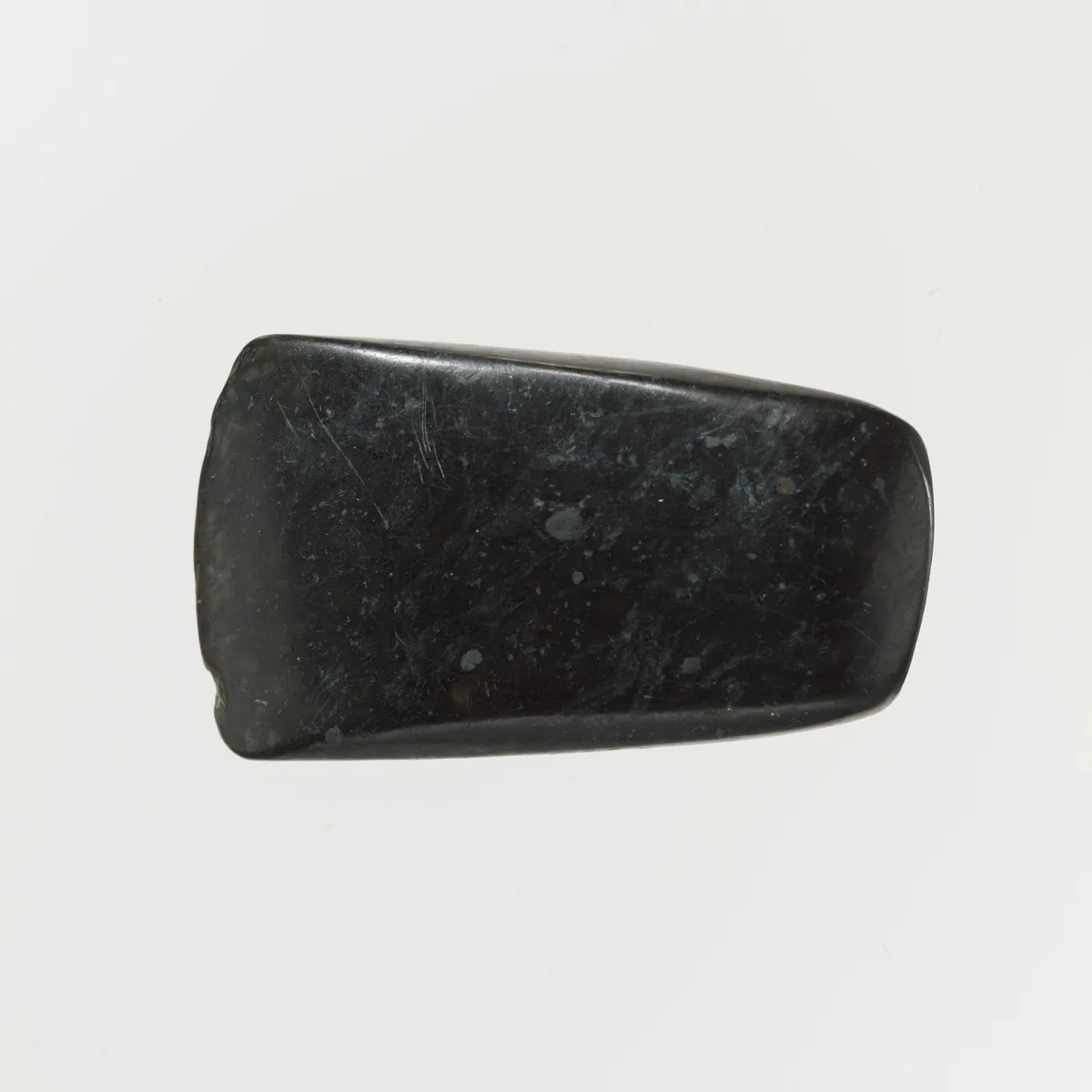
The stone axe below is a museum object from Crete, dated to the fifth-fourth millennium BCE. It belongs to another regional framework and postdates this page’s main Neolithic range. It supports comparison of material and form only; its date must not be transferred to the southern Levant.
Serpentinite axehead from Crete, fifth-fourth millennium BCE; 4.7 cm long. A regional comparison for stone working, not a Levantine find. The Met, 26.31.504.The Metropolitan Museum of Art · 26.31.504 · Bequest of Richard B. Seager, 1926 · CC0 · Source · CC0 1.0
Source
Sources and further reading
The research and references behind this page. Rights to external content remain with their owners.
Adjust the reading experience to suit you. These tools complement your browser and device accessibility settings. Changes apply to this page; only an explicit choice to remember them saves them for another visit.
Your choices apply to this page only. Moving to another page restores the defaults.