READING JOURNEY · SIX PERIODS · 4 min read, approximately
The Levant in six stops: from slingstones to an aqueduct
Six finds, six periods of the site's Levant scheme, one source per stop. The bar above the text marks where you are on the timeline as you read.
The explanations distinguish finds, interpretations and open questions. Sources appear at the end of the page.
The site orders the finds of the Levant by one scheme of periods, whose source and bounds are documented on the periods page. This article passes through six of them, one stop per period, choosing at each stop one find that has a record on the site and a source of its own. It does not tell "the story of the Levant"; it shows what a dated find looks like in each period, and what kind of source stands behind it: an excavation report, a collection record, a museum page.
The Late Pottery Neolithic · Wadi Rabah frame: approximately 5650-4850 BCESlingstones: organised production before cities
The first stop is not one object but an assemblage. Researchers examined slingstone assemblages from ‘En Ẓippori and ‘En Esur, in Late Pottery Neolithic and Early Chalcolithic contexts of approximately 5800 to 4500 calibrated BCE, and proposed organised weapon production on the basis of the assemblages' characteristics. Source 1. The site's article on the slingstones explains why the important unit here is the group and not the single stone, and why "organised production" is not evidence of a particular battle.
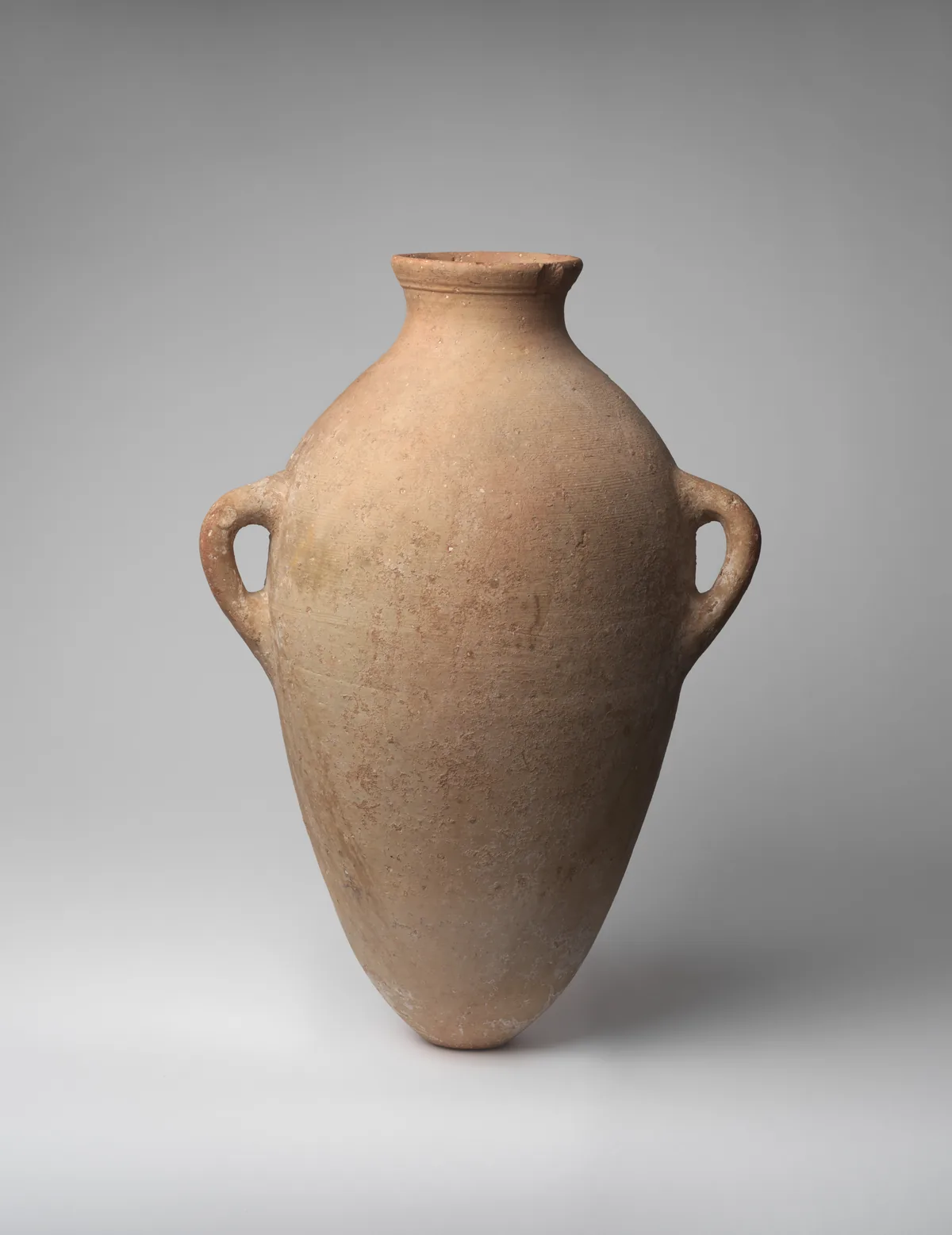
The Bronze Age · Approximately 3300-1200 BCEA Canaanite jar: a vessel from the Levant with no findspot
The second stop is a large pottery vessel, 59.5 cm high, whose collection record dates it "ca. 1500-1400 BCE", to the Late Bronze Age, and assigns it to Canaanite culture and the geography "Levant". There is no findspot in the record. Source 2. The placement in the Bronze Age on the timeline is "per the museum": the period name in the record matches the scheme, so the site uses it and marks the basis.
The Iron Age · Approximately 1200-586 BCELachish Letter VIII: ink on an excavated sherd
The third stop was excavated. An ostracon from Lachish, a "body fragment of wheel-made vessel" with a Hebrew inscription in ink, whose findspot in the record is "Lachish (historic), Bastion E.18:C". The record gives a period ("Iron Age") and no numeric date, and notes that the ink is "very faded". Source 3. Here the placement is by the source's period, with no year range: the site does not invent a date the record did not give.
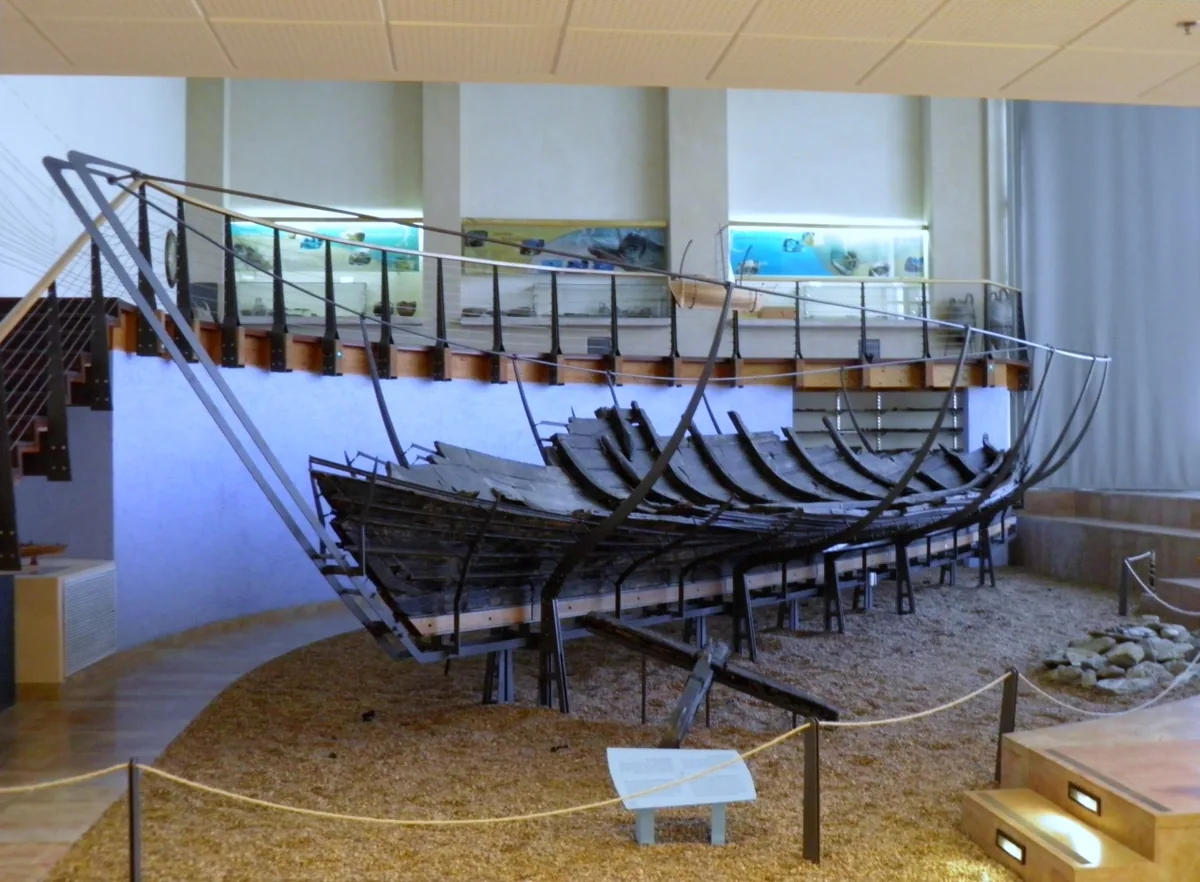
The Persian period · Approximately 539-331 BCEThe Ma'agan Mikhael ship: a date from two kinds of evidence
The fourth stop is a fairly complete ship: keel, sternpost, planks, 14 ribs, a mast base and an anchor. The museum's page dates it to "the late fifth century BCE (ca. 400 BCE)" on the basis of radiocarbon tests and the pottery found with it, and tells that it was found in August 1985 about 70 metres from the shore. Source 4. "The late fifth century" falls within the Persian period of the scheme, and the placement is marked as editorial with the source quoted, because the museum's page does not use the period name.
The Roman period · Approximately 64 BCE-330 CEThe Qula hoard: 2,019 coins and a question of date
The fifth stop is a hoard: 2,019 third-century CE coins found in a farmhouse in the hinterland of Diospolis (Roman Lydda). The publication's official abstract gives the deposition both as "the early 290s CE" and as "the late 290s CE", so the research card on the site marks the date as disputed within the source. Source 5. This stop shows that even a well-dated find can leave a question open, and that the site keeps it open.
The early Islamic period · Approximately 640-1099 CEThe aqueduct to Ramla: a structure as evidence of a period
The sixth stop is not a portable object but a structure: a section of aqueduct near Kibbutz Na‘an, published within a discussion of the Umayyad aqueduct to Ramla. The research card on the site separates the section that was exposed and measured from the reconstructed route. Source 6. The placement in the early Islamic period comes from the publication itself.
What the six stops teach about the timeline
- One source per stop, and the kind of source varies: an excavation report, a collection record, a museum page, a research abstract.
- Three kinds of period placement: by the period name in the source, by a year range that falls within the period, and by a quoted source where the name does not appear. Each object's page marks which applies.
- An object with no findspot takes part in the timeline if its source has a date, but its page says what is missing.
- What has no date in its source is not placed. The Cypriot amphora and the Galilee boat appear on the site, but not on this timeline.
Source
Sources and further reading
The research and references behind this page. Rights to external content remain with their owners.
- 1
Up in Arms: Slingstone Assemblages from the Late Prehistoric Sites of ‘En Ẓippori and ‘En Esur
Gil Haklay, Hendrik Bron, Dina Shalem, Ianir Milevski, Nimrod Getzov · 2023 · Checked
Research record in this library - 2
Canaanite jar, collection record 2001.761.9
The Metropolitan Museum of Art · Checked
- 3
Lachish Ostracon VIII (Lachish Letter VIII), collection record 125704
British Museum · Checked
- 4
הספינה ממעגן מיכאל (עמוד מוזיאון הכט, אוניברסיטת חיפה)
Hecht Museum, University of Haifa · Checked
- 5
A Hoard of Antoniniani from Qula
Robert Kool · 2016 · Checked
Research record in this library - 6
The Umayyad Aqueduct to Ramla and Other Finds near Kibbutz Na‘an
Amir Gorzalczany · 2011 · Checked
Research record in this library