The photograph could not be loaded
Documented object · Cretan, per the catalogue
Small serpentinite axe from Crete
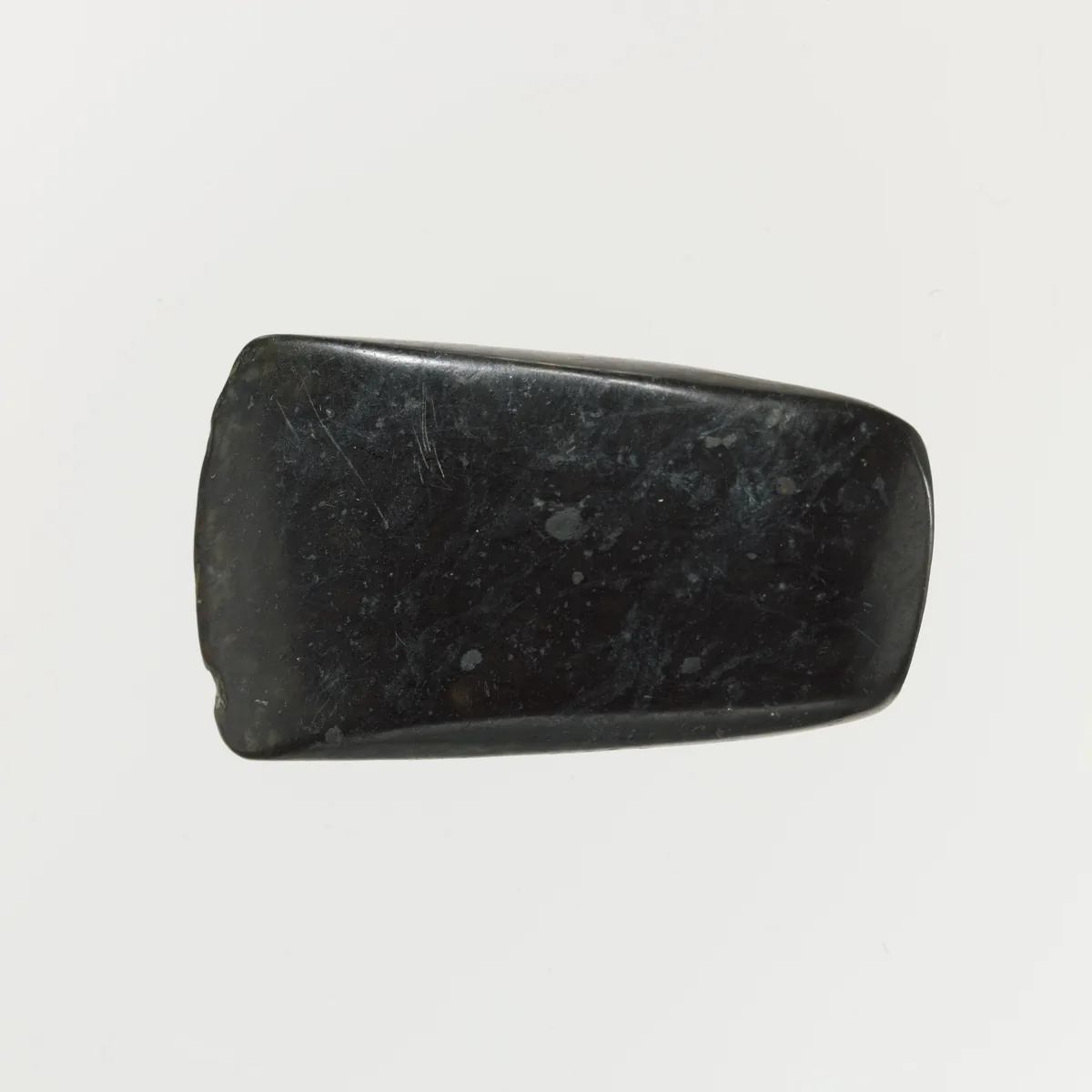
A polished stone tool less than five centimetres long, which the record describes in one word: "celt". A Neolithic object from Crete that recalls how long the Neolithic is outside the Levant too.
Date as given by the source5th-4th millennium BCEAs worded by the source: 5th-4th millennium BCE; Neolithic
What you see
What you see
A small polished stone tool, 4.7 cm long and 2.7 cm wide, shaped like an axe blade. The material is serpentinite, a greenish stone. The record's whole description is one word: "Celt", the term for a polished stone or metal tool shaped like a blade. The photograph is the collection image. Source 1.
What the record says
The record dates the axe "5th-4th millennium BCE", to the Neolithic, and assigns it to Cretan culture. No findspot is given. The object came from the bequest of Richard B. Seager in 1926 and is on view in Gallery 171.
A short record, long questions
Such a tool invites questions about the raw material, the polishing and the use; the record answers none of them. The site's slingstones article shows how a group of similar stone objects is examined as an assemblage; the article on materials and exchange explains what is needed to claim that a material came from afar. Here there is one object without context, and that is exactly what the page says.
Its place on the timeline
The Neolithic of Crete is not the Neolithic of the Levant, even if the names are the same. The axe is recorded in the Aegean region and appears under the Aegean tab by source date, with no assignment to a Levantine period.
Where it is now
Held by The Metropolitan Museum of Art, record 26.31.504. On 22 October 2026 the record stated "On view at The Met Fifth Avenue in Gallery 171".
The object's connections
The object's connections
Culture, period, place, type and holder: every connection comes from the record or a cited source.
Object
Small serpentinite axe from Crete
Region
Displayed at
- The Metropolitan Museum of Art, New YorkGallery 171, The Met Fifth Avenue
Compare
- Bronze spearhead from CyprusTwo tools from the large islands: a polished stone axe from Crete versus a bronze spearhead from Cyprus, some four thousand years apart; neither record gives a findspot
Source
Sources and further reading
The research and references behind this page. Rights to external content remain with their owners.
- 1
Small serpentinite axe, collection record 26.31.504
The Metropolitan Museum of Art · Checked

