The photograph could not be loaded
What to look for in the photograph
What to look for in the photograph
Details the record or source describes; every point cites its basis.
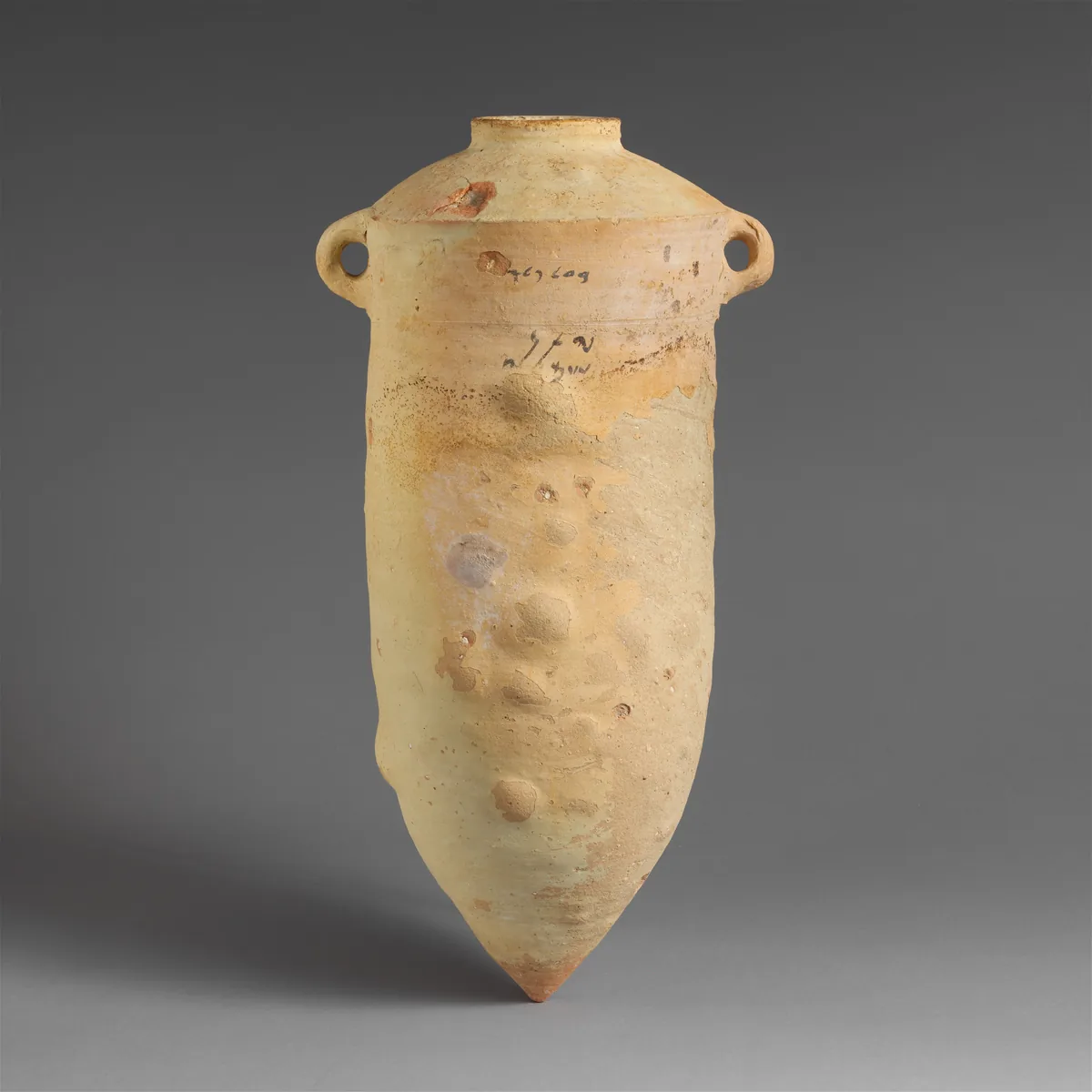
- 1 The upper line: a name, probably the owner's
The catalogue reads the upper line as "Baalpilles, probably the name of the owner" and keeps the uncertainty. The inscription tells of the writer, not necessarily of the vessel's origin.
Per source 1 ·Baalpilles, probably the name of the owner
- 2 The lower line: "Yaton, inspector"
Below, per the catalogue: "Yaton, inspector". Two names and one title; the record does not explain the relation between them.
Per source 1 ·below, Yaton, inspector
Documented object · Inscriptions · Cypriot, per the catalogue
Cypriot amphora with a Phoenician inscription
A Cypriot vessel, a Phoenician inscription and a findspot nobody recorded: one object that teaches us to separate what is written on it from where it came from.
Date as given by the source6th-5th century BCE
What you see
What you see
A pale clay amphora, 57.8 cm high, with two handles, a short neck and a pointed base. Between the handles, three lines of a painted Phoenician inscription. The photograph is the museum's own collection image, shown without cropping or reconstruction.
What the record says
The collection record dates the amphora to the 6th-5th century BCE and classifies it as Cypriot. According to the catalogue, the top line gives the name Baalpilles, probably the owner, and below it the name Yaton with the title “inspector”. The word “probably” belongs to the record itself: identifying the owner is a proposal, not an established fact. Source 1.
An inscription is not a certificate of origin
The script is Phoenician, the vessel is catalogued as Cypriot, and the record names no findspot. The three statements do not contradict each other: the amphora itself shows that Phoenician writing appears on objects classified as Cypriot, and writing on a vessel tells us about whoever wrote on it and how it was used, not necessarily where it was made. This page therefore keeps the three apart: the catalogue's cultural classification, the language of the inscription, and a findspot that was not recorded.
Where the object is now
The amphora belongs to the Cesnola Collection, purchased by subscription in 1874-76, and is held by The Metropolitan Museum of Art in New York as record 74.51.2300. On 22 October 2026 the record stated that the object was on view in Gallery 171 at The Met Fifth Avenue; display changes, and the official record is the current source. The exact findspot does not appear in the record and is not supplied here.
Its place in time
The period scheme on this site describes the southern Levant. The date “6th-5th century BCE” overlaps in years with the late Iron Age and the Persian period of that scheme, but the vessel is Cypriot and the Levantine period names do not describe it. The object is therefore not placed on the timeline and is shown by its source date. When a scheme for Cyprus is defined on this site, it can receive a place there with a documented basis.
How to read the photograph
The photograph is enough to identify the shape of the vessel, but the letters are too small to read on screen. The reading given here is the catalogue's reading, not an independent observation. To check it, go to the original record and to the publications of the Cesnola Collection.
The object's connections
The object's connections
Culture, period, place, type and holder: every connection comes from the record or a cited source.
Object
Cypriot amphora with a Phoenician inscription
Region
Kind of find
Displayed at
- The Metropolitan Museum of Art, New YorkGallery 171, The Met Fifth Avenue
Discussed in
On the trail
Source
Sources and further reading
The research and references behind this page. Rights to external content remain with their owners.
- 1
Terracotta amphora with Phoenician inscription, collection record 74.51.2300
The Metropolitan Museum of Art · Checked