Reading trail · 5 steps
Three inscriptions, three museums
How an inscription travels from the excavation to the collection: a sherd from Lachish in London, basalt from Tel Dan in Jerusalem, a Cypriot amphora in New York. Five steps, each saying why it is here and what was checked.
The photograph could not be loaded
Three inscriptions from the Iron Age and a little after, three media (ink on a sherd, carving in basalt, an inscription on a clay vessel) and three museums in three cities. The trail does not claim that the inscriptions are related to one another; it follows the question of what is known about each, where the information comes from, and what happened to the object between the excavation and the display case.
Each step links to a page on this site when one exists in this language, and otherwise to the museum's official page. A step without a page is not deleted: it stays on the trail with its reason.
The steps
-
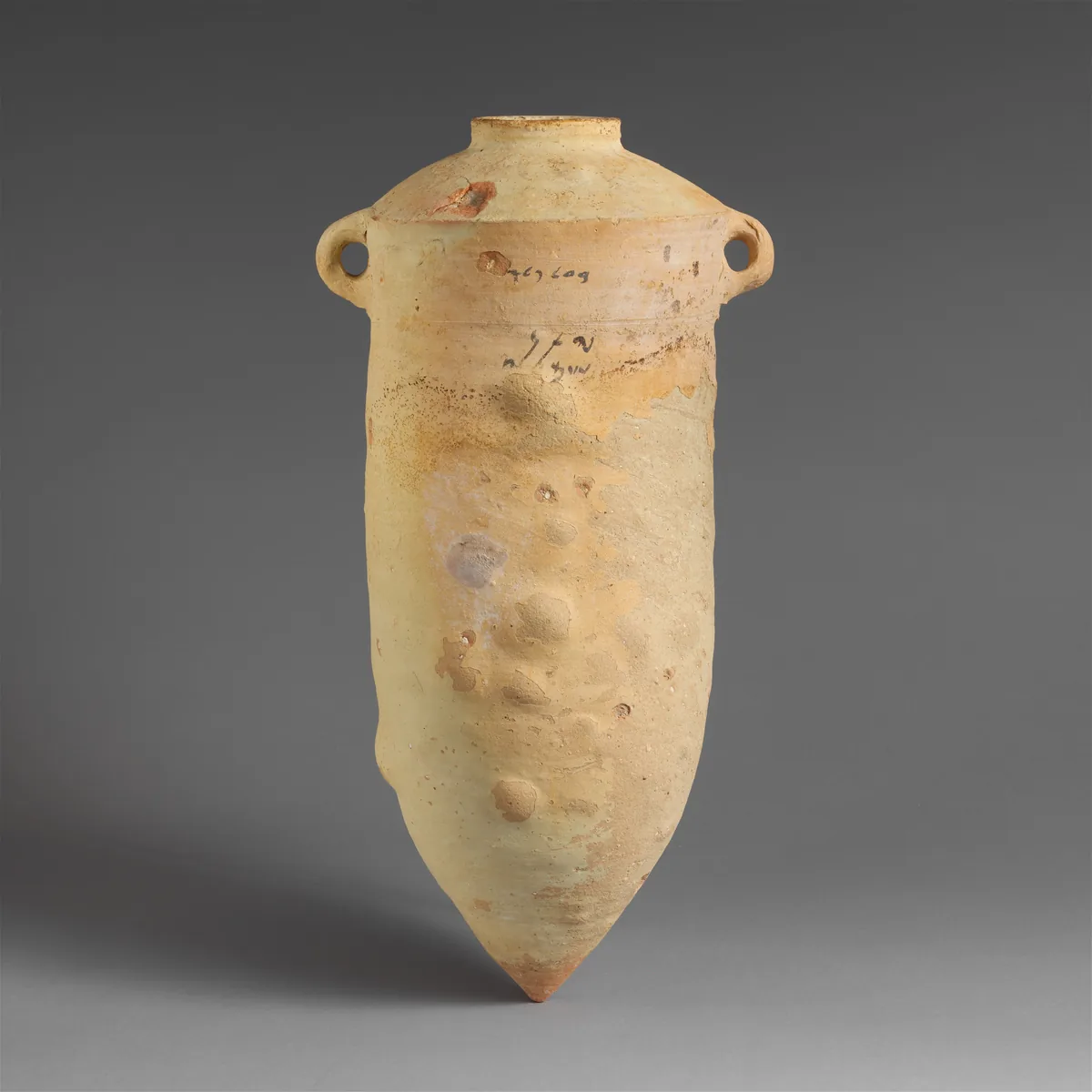
Detail of the photograph: Cypriot amphora with a Phoenician inscription The upper line: a name, probably the owner's.The Metropolitan Museum of Art · 74.51.2300 · The Cesnola Collection, Purchased by subscription, 1874-76 · CC0 · Source · CC0 1.0 Step 1 · RESEARCH & METHOD
Reading an ancient inscription: from mark to claim
Photograph, transcription, reconstruction and translation are different steps. A guide to reading names, numbers and meaning on objects.
Open this stepWhy this step
Before the objects: how an inscription is read. The article separates script, language and medium, and explains what a reading can and cannot establish. Its two examples are exactly the next two stops.
-
No photographText frame in place of a photograph
Lachish Letter VIII
- Material
- Pottery
- Dimensions
- Length 6.40 cm; width 9.50 cm; thickness 0.30-0.50 cm
- Date as given by the source
- Iron Age; no numeric date in the record
- Record number
- 125704 · 1959,0711.4
- Held by
- The British Museum, London
The source states no licence for its image, so it is not reproduced here
Step 2 · Object
Lachish Letter VIII
A sherd of a pottery vessel with a Hebrew inscription in ink, found at Lachish and on display today in London. The ink is very faded, the record gives no numeric date, and it must not be confused with Letter II.
Open this stepWhy this step
Ink on a sherd. A letter found in excavation at Lachish, with a registration number, a findspot and a condition note ("ink very faded"), on display today in London.
Per source 1 ·On display (Room 57 - Ancient Levant, Display Case 10)
· Verified -
The photograph could not be loaded
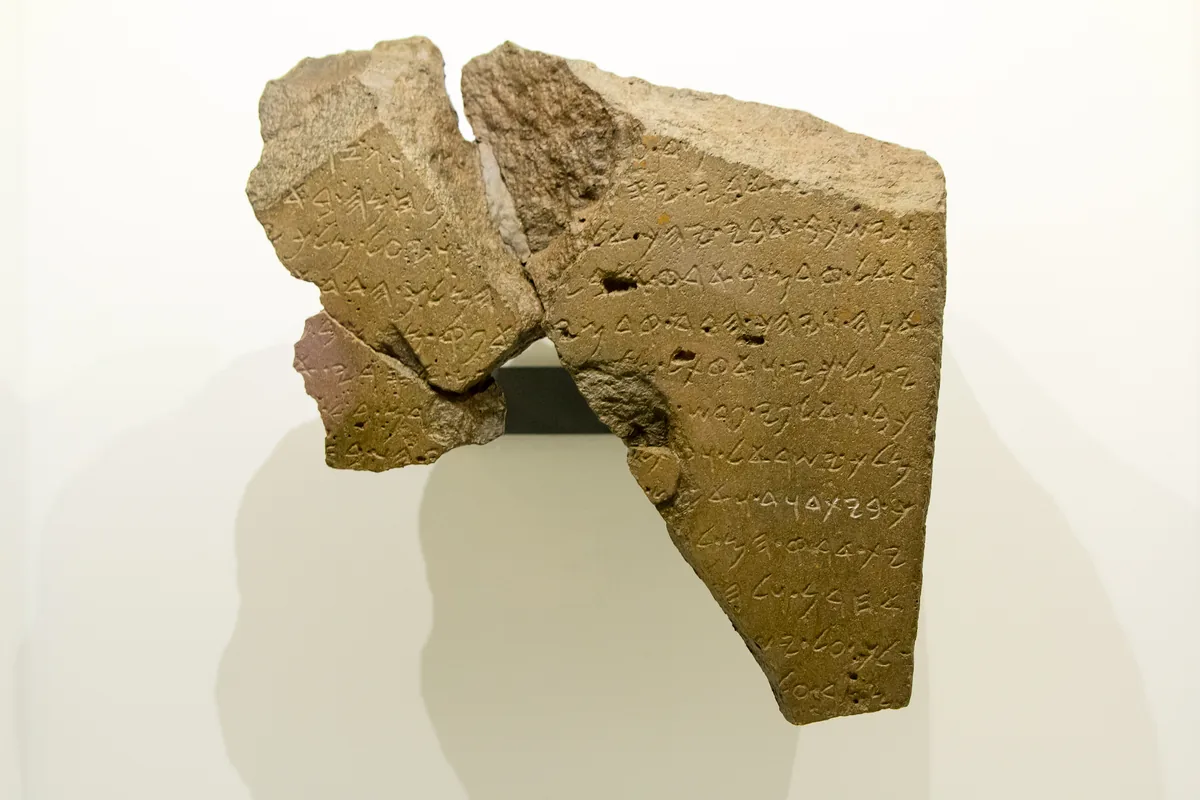
Photograph of the object The Tel Dan stele at a temporary exhibition at the Bible Lands Museum, Jerusalem, February 2017: a visitor's photograph, not the record's image. The stele is held by the Israel Museum, Jerusalem (record 371407-0).Oren Rozen · Wikimedia Commons · CC BY-SA 4.0 · Source · CC BY-SA 4.0 Step 3 · Object
The Tel Dan stele: "House of David"
A fragment of a basalt stele with an Aramaic inscription, found at Tel Dan and held by the Israel Museum. The photograph here is a visitor's photograph from a temporary exhibition at the Bible Lands Museum in 2017 (CC BY-SA 4.0), not the record's image; the museum's own image is seen in the record.
Open this stepWhy this step
Carved in basalt. An inscription found in excavation at Tel Dan and held in Jerusalem. The page says explicitly what the record states and what it does not, and makes no claim that the stele is on display.
Per source 2 ·Iron Age II, 9th century BCE
· Verified -
Detail of the photograph: Cypriot amphora with a Phoenician inscription The lower line: "Yaton, inspector".The Metropolitan Museum of Art · 74.51.2300 · The Cesnola Collection, Purchased by subscription, 1874-76 · CC0 · Source · CC0 1.0 Step 4 · Object
Cypriot amphora with a Phoenician inscription
A Cypriot vessel, a Phoenician inscription and a findspot nobody recorded: one object that teaches us to separate what is written on it from where it came from.
Open this stepWhy this step
A Phoenician inscription on a Cypriot vessel, with no findspot in the record. The stop that shows an inscription tells of its writer, not necessarily of the vessel's origin. On view in New York.
Per source 3 ·On view at The Met Fifth Avenue in Gallery 171
· Verified -
Step 5 · External page
Lachish Letter II, British Museum collection record
Official pageWhy this step
The official record of Lachish Letter II, in the same museum and the same display case. The other Lachish letters are not documented here as pages, so this step leads straight to the official record; Letter VIII and Letter II must not be merged.
Per source 4 ·On display (Room 57 - Ancient Levant, Display Case 10)
· Verified
Places on the trail
Where it was found
- LachishFindspot per the record
- Tel DanFindspot per the record
Schematic map: simplified coastlines, not to scale; positions follow the cited records.
End of the trail
End of the trail
From here, continue to an object, a period or another trail.
Back to the overviewSource
Sources and further reading
The research and references behind this page. Rights to external content remain with their owners.
- 1
Lachish Ostracon VIII (Lachish Letter VIII), collection record 125704
British Museum · Checked
- 2
Tel Dan stele ("House of David" inscription), Israel Museum collection record 371407-0
The Israel Museum, Jerusalem · Checked
- 3
Terracotta amphora with Phoenician inscription, collection record 74.51.2300
The Metropolitan Museum of Art · Checked
- 4
Lachish Ostracon II (Lachish Letter II), collection record 125702
The British Museum · Checked