The photograph could not be loaded
What to look for in the photograph
What to look for in the photograph
Details the record or source describes; every point cites its basis.
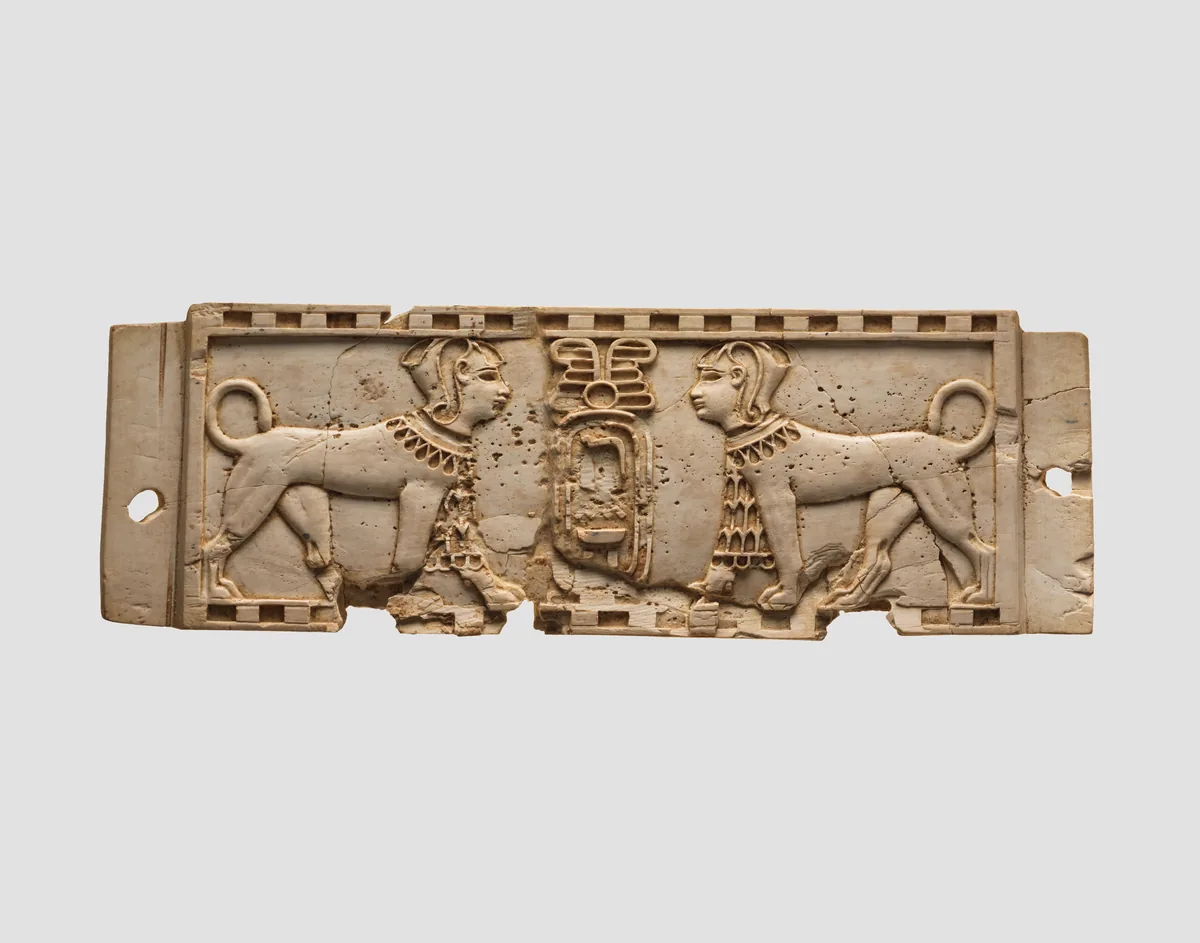
- 1 A sphinx (one of two)
"Two sphinxes flanking a central cartouche". The museum attributes the plaque to the Phoenician style, in part on the sphinxes' slender leonine bodies.
Per source 1 ·two sphinxes flanking a central cartouche
- 2 The cartouche with a solar disc and plumes
A central cartouche "crowned by a solar disc and ostrich plumes", per the curatorial text.
Per source 1 ·a central cartouche crowned by a solar disc and ostrich plumes
- 3 A tenon with a drilled hole
"Two tenons projecting from the shorter sides suggest that this piece was originally fitted into a frame"; the tenons have drilled holes for dowels.
Per source 1 ·Two tenons projecting from the shorter sides ...
- 4 Empty cloisonné cells
Cells (cloisons) cut into the surface for inlays of coloured glass or stones; "none of the inlays have survived". The cells remain on the collars and aprons.
Per source 1 ·None of the inlays have survived
Documented object · Assyrian, per the catalogue; the style is attributed in the record to the Phoenician
Ivory plaque from Nimrud with two sphinxes
An ivory furniture plaque excavated in 1962 at Fort Shalmaneser, Nimrud: two sphinxes flanking a cartouche. The record attributes the style to the Phoenician and notes that none of the inlays survived.
Date as given by the sourceca. 9th-8th century BCEAs worded by the source: ca. 9th-8th century BCE; Neo-Assyrian
What you see
What you see
A rectangular carved plaque, 15.7 cm wide and 5.2 cm high, with two sphinxes flanking a central cartouche crowned by a solar disc and ostrich plumes. The surface is divided into small cells (cloisonné) that were meant to hold inlays; according to the record, "none of the inlays have survived". The photograph is the collection image. Source 1.
What the record says
The record dates the plaque "ca. 9th-8th century BCE", to the Neo-Assyrian period, and assigns it to Assyrian culture; it attributes the style to the Phoenician, on the basis of the sphinxes' slender leonine bodies, the Egyptianizing cartouche and the cloisonné technique. The plaque was excavated in 1962 under Max Mallowan and found in a large storeroom at Fort Shalmaneser, a royal building at Nimrud. The museum acquired it that year through its financial contribution to the excavations. It is not currently on view.
Phoenician ivory in an Assyrian palace
According to the record, the palaces and storerooms of Nimrud held thousands of carved ivories, mostly furniture inlays, which most likely arrived as tribute from vassal states or as booty, and the tusks were almost certainly from African elephants. One object thus links three places: a style attributed to Phoenicia, a findspot in Assyria and a material from far away. The article on materials and exchange explains why each such link is a separate claim needing its own evidence.
What can be compared with the Jerusalem ivories
The article on the Iron Age ivories of Jerusalem uses this plaque as a comparison: technique, motifs and style can be compared; the origin of the Jerusalem ivories, their date of arrival or where they are displayed cannot be inferred from it. The Nimrud plaque is not one of the Jerusalem panels.
Its place on the timeline
"Neo-Assyrian" is a period in the scheme of Mesopotamia. In the site's period scheme for Mesopotamia the plaque is placed in the Neo-Assyrian period, by the period name in its record, and appears under the Mesopotamia tab; it is not assigned to the Levantine Iron Age even though the dates overlap.
Where it is now
Held by The Metropolitan Museum of Art, record 62.269.4. On 22 October 2026 the record stated "Not on view".
The object's connections
The object's connections
Culture, period, place, type and holder: every connection comes from the record or a cited source.
Object
Ivory plaque from Nimrud with two sphinxes
Period
- The Neo-Assyrian period: capitals and reliefsPer the museum
Region
On the trail
- Trade across the seaStep 5
Source
Sources and further reading
The research and references behind this page. Rights to external content remain with their owners.
- 1
Cloisonné furniture plaque with two sphinxes flanking a cartouche, collection record 62.269.4
The Metropolitan Museum of Art · Checked